Third Class
1870 · Third Class · Work 378 of 1,871
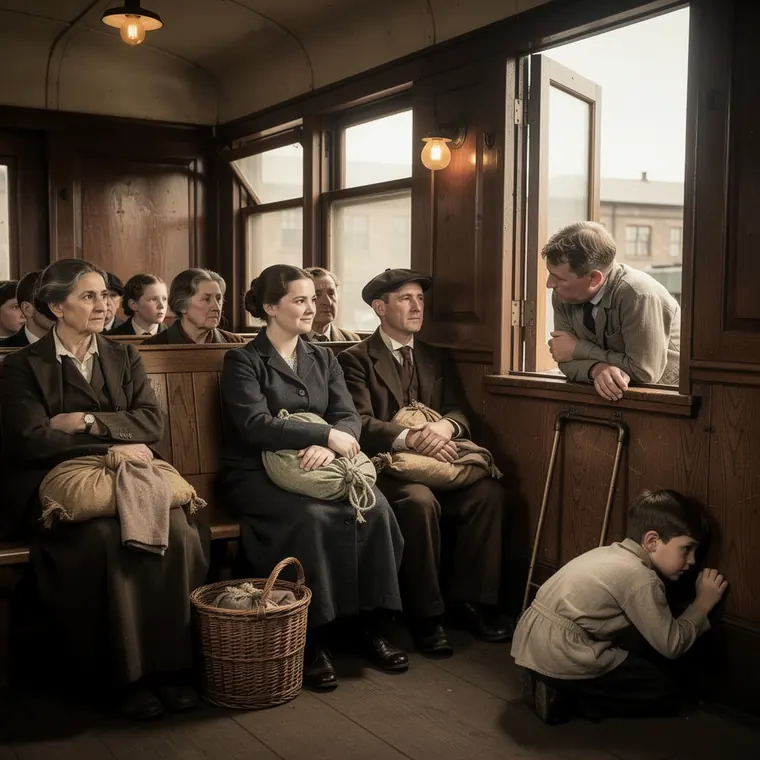
Families seated close on wooden benches in a third class railway carriage, baskets and bundles stacked between knees, a boy kneeling to look through the drop window.
- What it was used for
- Third class carried the poorer travellers; according to The Victorian Commons the cheap statutory trains were originally intended to create a more mobile workforce. The Railway Regulation Act 1844 (7 & 8 Vict. c. 85, royal assent 9 August 1844) required, in its text on legislation.gov.uk, at least one train each way on every week-day calling at all ordinary stations, in carriages protected from the weather and provided with seats, at a fare not exceeding a penny a mile and at a speed not less than 12 miles an hour including stoppages. Companies met the duty with awkward departure times and slow trains; The Victorian Commons documents a 6 a.m. service from Dorchester that left passengers four hours at Southampton in winter.
- What was new
- What was new in 1844 was not third class - that existed before - but that the state prescribed it as a minimum service with a price ceiling, a minimum speed and an obligation to stop, instead of leaving it to the companies' discretion. Second, it was new that a company went beyond the statute of its own accord: the 1901 DNB supplement gives the Midland Railway third class on all trains with effect from 1 April 1872 and the abolition of second class with effect from 1 January 1875 - both dates of effect, not of decision - and names competition with the Great Northern as one of the chief reasons for 1872. Most railway managers at the time regarded this course as revolutionary. The barb: what was forced as alms became the business. J. Holt Schooling, in The Railway Magazine of July 1903, gave for 1901 91.2 out of every 100 passengers travelling third class and 76.8 per cent of passenger receipts, against 12.5 per cent first and 10.7 per cent second.
Further reading
- The Select Committee of 1844 on Railways - VictorianWeb (Beschlüsse des Select Committee, Parliamentary Papers 1844, XI, S. 9-11)
- Virtually a fourth class of passenger carriage: the parliamentary train - The Victorian Commons
- Dictionary of National Biography, 1901 supplement: Allport, James Joseph (Midland: dritte Klasse ab 1.4.1872, zweite Klasse abgeschafft 1.1.1875)
- Railway Statistics - The Railway Magazine, Juli 1903 (J. Holt Schooling, Zahlen für 1901), wiedergegeben bei Roger Farnworth
- Rail Fares resource pack - National Railway Museum (ein Penny je Meile gesetzlich ab 1844)
- Railway Regulation Act 1844 (7 & 8 Vict. c. 85), as enacted, legislation.gov.uk (königliche Zustimmung 9. August 1844, Bedingungen der Pflichtzüge)