The Trapper Boy
1842 · Pit Boy · Work 380 of 1,871
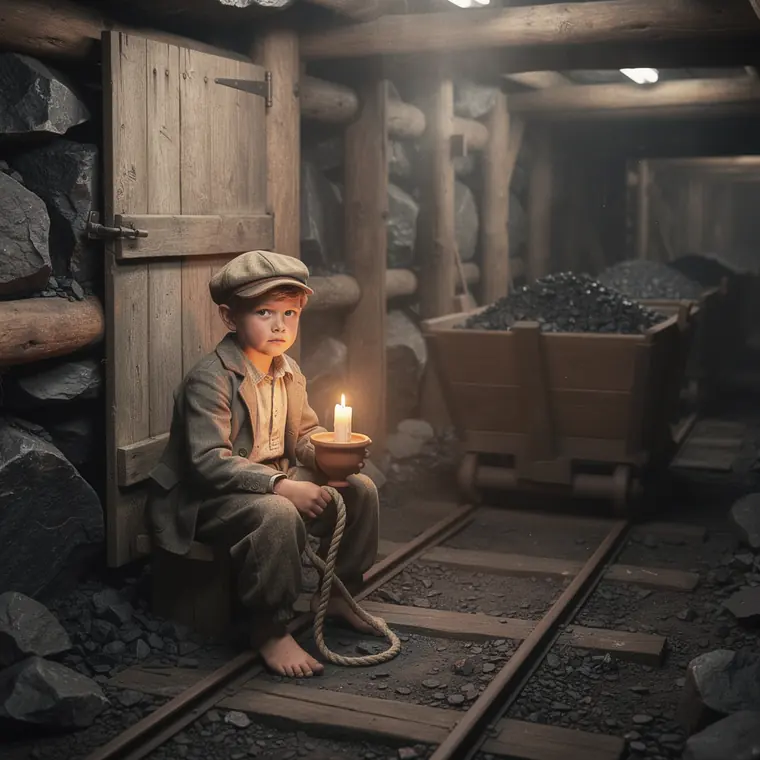
A young trapper boy seated beside a ventilation door in a coal roadway, rope in hand, a full tub rumbling past on wooden rails, his candle set in a clay holder, the boy in a ragged linen shirt, a short jacket and loose trousers of coarse cloth, barefoot or in worn leather boots, a cloth cap, the roadway walled with rough coal and rock and propped with timber, the door of rough planks, darkness beyond the candle.
- What it was used for
- The trapper sat at a ventilation door in the seam and opened it for the coal wagons so that the air current was not short-circuited. The National Coal Mining Museum for England describes him as the youngest child of a family unit underground, sitting in a darkened space, some as young as five; children there typically worked twelve hours a day, six days a week. In the First Report of the Children's Employment Commission (Mines), 1842, John Saville, aged seven, a trapper, states that he stands and opens and shuts the door, is generally in the dark and sits down against it, and now sees daylight only on Sundays - paraphrased from the museum's extracts. Sarah Gooder, aged eight, a trapper at Gawber Pit, says she goes in at four or half past three in the morning and comes out at five or half past.
- What was new
- What was new was the recording. The 1842 report took down the children's own statements through sub-commissioners on the spot: age, length of shift, place of work. Carolyn Tuttle gives, for 1842, children and youths as 19 to 40 per cent of the workforce in coal and metal mines, and one third of the underground coal workforce as under 18 - drawn from the 1842 First Report. The Mines and Collieries Act, royal assent 10 August 1842, forbade underground work to females of any age and to boys under ten. The barb: the ten-year-old trapper stayed, the mother had to go; Kuntala Lahiri-Dutt writes that the Act pushed women into more insecure areas of work. Already on 6 August 1842 Lord Ashley told the Commons that the Lords' amendments had weakened the bill; the Commons agreed to them.
Connections
Every connection names its kind. “Forerunner” on its own would be a claim.
- Works withWettertuer im Durham-Revier1842The ventilation door was the trapper's place of work. Leifchild's 1842 commission report for Northumberland and north Durham calls the door-keepers the youngest children in the mine and the "keepers of the lives of scores of human beings". Of the main doors there were commonly two, an air lock for the rolleys, and the boys were directed never to allow two of them to be open at once.Source: J. R. Leifchild, Children's Employment Commission 1842, Report on the Collieries of Northumberland and the North of Durham, S. 11, 12 und 32 der Transkription (Coal Mining History Resource Centre)
Further reading
- National Coal Mining Museum for England, Extracts from the 1842 Children's Employment Commission (PDF) - Aussagen von John Saville und Sarah Gooder
- National Coal Mining Museum for England, Voices in the Coalshed: Career Options (Trapper als jüngstes Kind, zwölf Stunden, sechs Tage)
- National Coal Mining Museum for England, Background Information: The 1842 Royal Commission (PDF)
- UK Parliament, Living Heritage: Coal mines
- Mines and Collieries Act 1842 (5 & 6 Vict. c. 99), Statutentext mit Zustimmungsdatum 10. August 1842 (vLex UK)
- Hansard, House of Commons, Mines and Collieries' Bill, 6. August 1842 (Lord Ashley zu den Änderungen der Lords)
- Carolyn Tuttle, Child Labor during the British Industrial Revolution, EH.Net Encyclopedia
- Kuntala Lahiri-Dutt, The act that shaped the gender of industrial mining, The Extractive Industries and Society 7/2 (2020)