The Tap Room
1880 · Public House · Work 387 of 1,871
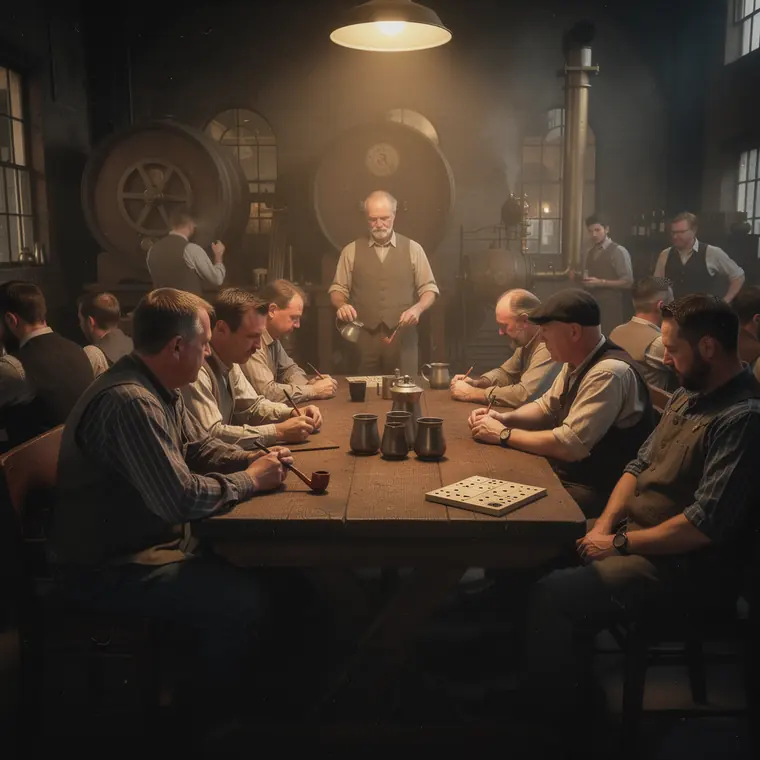
Men crowded in a tap room after shift, clay pipes and pewter pots on the settle table, a landlord drawing beer from a cask, a domino game on the bench.
- What it was used for
- The tap room was labour exchange, pay office and waiting room. In "London Labour and the London Poor" Henry Mayhew describes the London coalwhippers: before an Act of 1843 they were hired and paid by the publicans along the river from Tower Hill to Limehouse, at seventy taverns on the north side by Mayhew's account. A man wanting work crowded round the bar and outbid the others in his order, because he who spent most in the public house had the best chance of employment. Mayhew reckons twelve shillings of drink per ship, 10,000 ships a year, nine men to clear each ship — £54,000 annually, or £27 a year per man — and adds that this is considered an extremely low average. One whipper told him that out of 30 shillings a week he was compelled to spend 15 to 18 in drink, and that the publican often kept him waiting until eleven or twelve on Saturday night. Among the deal porters Mayhew counted twenty-four men in a small, dark tap room waiting to be paid.
- What was new
- What was new was not the tap room but its expropriation. By Mayhew's account three coalwhippers induced the legislature in 1843 to pass an Act forbidding the system and appointing commissioners to register the whippers, so that an office came into being where the men were thereafter employed and paid; Mayhew does not give that Act's official short title. The barb is the reversal: according to Mayhew none but the most dissolute and intemperate obtained employment, and only those in debt to the publican were sure of work on the next ship. Mayhew marks several of these statements as hearsay ("I am told", "I am credibly informed"). The name misleads too: Geoff Brandwood wrote in "Brewery History" in 2006 that every tap room he and his colleagues had encountered was slightly or often far removed from the servery, with a single known exception.
Connections
Every connection names its kind. “Forerunner” on its own would be a claim.
- EncounteredThe Union Meeting1889London dock strike, 1889: the Wade's Arms in Jeremiah Street, Poplar, was the strike centre. The landlady provided a meeting room and the food; in the first-floor room the strike committee discussed the conduct of the strike, including the placing of pickets and the distribution of strike pay.Source: Unite the Union, The Great Dock Strike of 1889 (2015), Abschnitt Strike headquarters, S. 40f. (PDF) · Beverley Cook, The 1889 London dockers' and tailors' strikes, London Museum (Wirtin des Wade's Arms stellt den Versammlungsraum)
Further reading
- Henry Mayhew, London Labour and the London Poor, Bd. III (erweiterte Ausgabe 1861-62), Volltext Project Gutenberg 57060
- James Kneale (UCL), schriftliche Stellungnahme AL 55 an den Health Committee, House of Commons, Session 2009-10 (Zahl der Schankstätten: ca. 115.000 um 1870, 96.000 um 1900)
- Geoff Brandwood, The vanishing faces of the traditional pub, Brewery History Nr. 123 (2006)