The Union Meeting
1889 · Union Meeting · Work 396 of 1,871
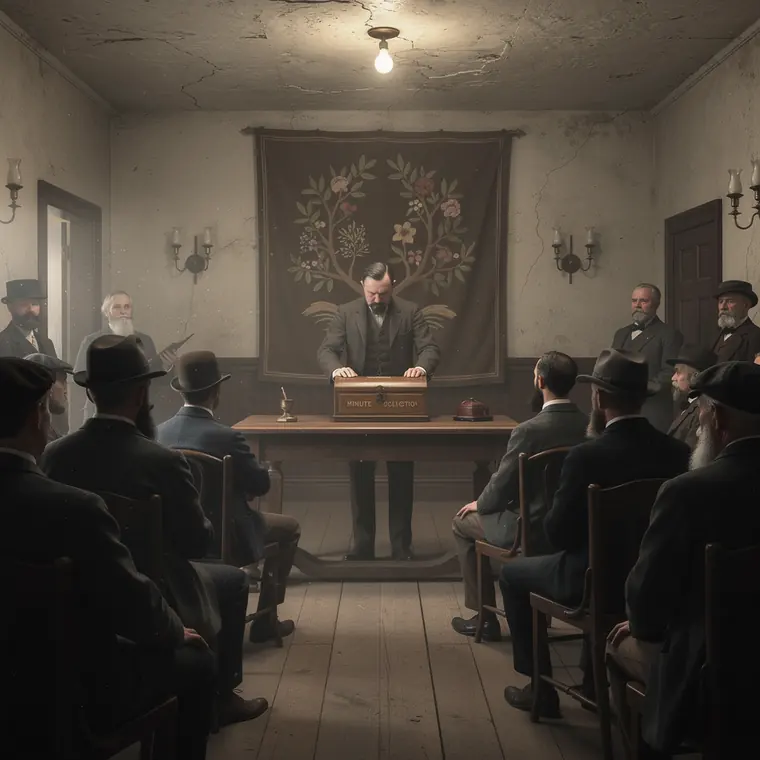
Union members packed into a hired upstairs room with a low plastered ceiling and plain walls, gas brackets on the walls, a speaker leaning over a table with a minute book and a collecting box, an embroidered branch banner hung on the wall behind him, the men in dark wool jackets, waistcoats, collarless shirts and cloth caps or bowler hats, moustaches and beards, the box and an inkwell.
- What it was used for
- In 1889 the meeting was the instrument. The London dockers demanded sixpence an hour, the tanner, and eightpence for overtime; on Saturday 14 September 1889, after five weeks on strike, an agreement was signed, and the tanner was awarded from 4 November along with the rule that no man was to be employed for less than four hours at a time. The number of strikers is an estimate and disputed: the London Museum gives up to 75,000 dockers, Guy Collender 150,000. Among the gasworkers it went faster: founded 31 March 1889, with 3,000 members within weeks on the TUC's account and, on Parliament's, about 800 men joining every day and over 20,000 within six months. In Germany the Ruhr miners' strike of May 1889 had, according to LeMO, close to 90,000 strikers and was with fourteen dead the bloodiest of the Empire.
- What was new
- What was demonstrably new was the speed and reach of organising the unskilled: TUC membership rose, on Unite's account, from 568,000 in 1888 to 1,094,000 in 1891. "The first mass strike of the unskilled" would be wrong: the walkout of 1,400 women at Bryant & May in 1888 and the Ruhr strike of May 1889 both precede the London August. Even the meeting place is disputed — the TUC puts the founding of the gasworkers' union at a meeting at the Beckton works, Parliament's biography at Canning Town Hall. The barb is double. The tanner was won and the gate remained: the same Unite booklet records that the casual system survived for decades after 1889. And about two thirds of the money came from Australia — over £30,000 of £47,000 raised in all on Unite's figures, £37,272 on Collender's, who relies on a statement by John Burns in 1890; the share is not in dispute, the sum is.
Connections
Every connection names its kind. “Forerunner” on its own would be a claim.
- EncounteredThe Tap Room1880In 1889 the meeting sat in a public house: for five weeks the London dock strike committee met on the first floor of the Wade's Arms in Poplar, whose landlady gave them the room and the food. The striking tailors' committee likewise used a pub, the White Hart in Greenfield Street.Source: Beverley Cook, The 1889 London dockers' and tailors' strikes, London Museum (beide Streikkomitees nutzten Pubs als Hauptquartier) · Unite the Union, The Great Dock Strike of 1889 (2015), Abschnitt Strike headquarters, S. 40f. (PDF)
Further reading
- Unite the Union, The Great Dock Strike of 1889 (2015)
- Beverley Cook, The 1889 London dockers' and tailors' strikes, London Museum
- TUC, Section: the great 1889 dockers' strike
- Guy Collender, “Hands across the sea”: Strikes, solidarity and diverging outcomes in port cities in Britain and Australia in the late nineteenth century, Coastal Studies & Society (SAGE) 2024
- TUC 150 Stories, Will Thorne
- UK Parliament, Will Thorne (1857-1946)
- The National Archives, The 1888 matchgirls' strike
- LeMO (Stiftung Deutsches Historisches Museum / Stiftung Haus der Geschichte), Arbeiterfrage und Streikbewegung
- Archiv im Haus der Geschichte des Ruhrgebiets, Bestand IG Bergbau und Energie (Gründung 18.8.1889 in Dorstfeld)