Market Day
1870 · Market Day · Work 389 of 1,871
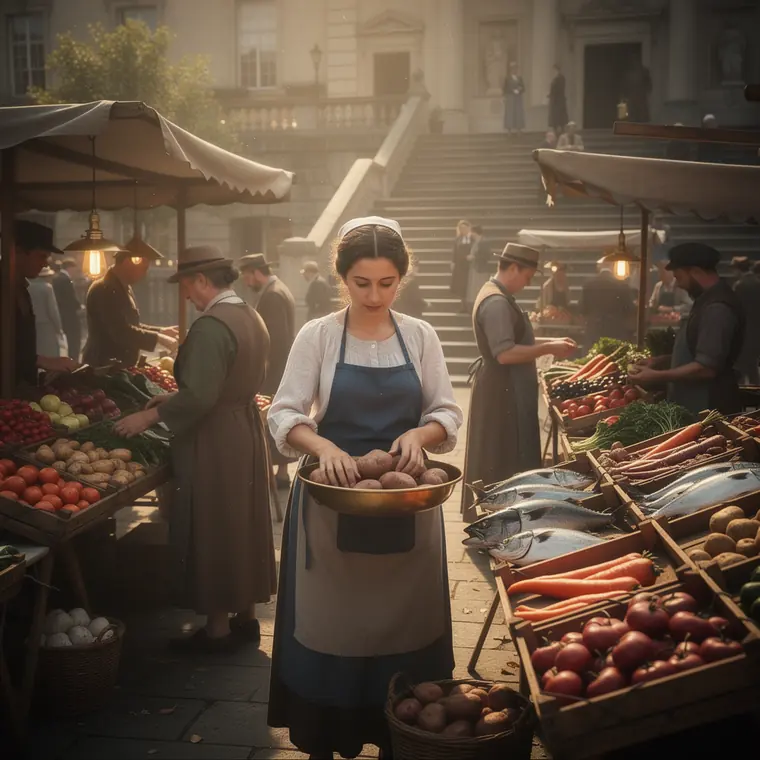
A crowded market square on a Saturday, stallholders calling over trestle boards of vegetables and fish, a woman weighing potatoes into an apron, town hall steps behind.
- What it was used for
- The industrial town's market was on Saturday night, and specifically after the wages were paid. Henry Mayhew writes that the working classes bought their Sunday dinner there and in the adjoining shops, and that after pay-time on Saturday night the crowd in the New Cut and the Brill in particular was almost impassable; hundreds of stalls, each with one or two lights, and the Sunday-morning market finished as the clock struck eleven. Mayhew's own list: 37 street markets in London, ten on the Surrey side and twenty-seven on the Middlesex side, 3,911 hucksters in all, an average of 105 to each market — his own survey, not an official statistic. Alongside this came the built market hall: Bolton Market Hall of 1854, architect G. T. Robinson, assessed by Historic England as an early example of large-scale municipal market development, with ornate cast-iron columns and a glazed roof over a cruciform plan.
- What was new
- What was new was the covered market hall built by the town — though Historic England's own blog hedges: the first massive market hall is thought to be St John's Market in Liverpool, 1822. It is not the priority that carries the story but the change of market lord: Historic England calls Bolton an early example of large-scale municipal market development; older are the royal grants of market, recorded on the Charter Rolls from 1199. The barb is that the obvious story does not hold. Mayhew describes a trade that lived off goods going stale: twenty to thirty men daily selling stale bread through some four summer months, bought from the bakers at a halfpenny to twopence a quartern below the shop price, and women who came at dusk as if they were ashamed to be seen. But the same seller tells him he does not sell more on a Saturday than on other nights. Bad bread was not a Saturday effect but a permanent condition; only the shame kept to an hour.
Further reading
- Henry Mayhew, London Labour and the London Poor, Bd. I (1851), Kapitel The London Street Markets on a Saturday Night, Volltext Project Gutenberg 55998
- Historic England, Market Hall and All Ground Floor Shops, Bolton, List Entry 1388092
- Historic England Blog (Heritage Calling), The Timeless Charm of English Market Towns and Halls, 14.03.2024
- Samantha Letters / Derek Keene, Gazetteer of Markets and Fairs in England and Wales to 1516 (Institute of Historical Research, 2003)