The Knife Grinder
1875 · Street Trading · Work 390 of 1,871
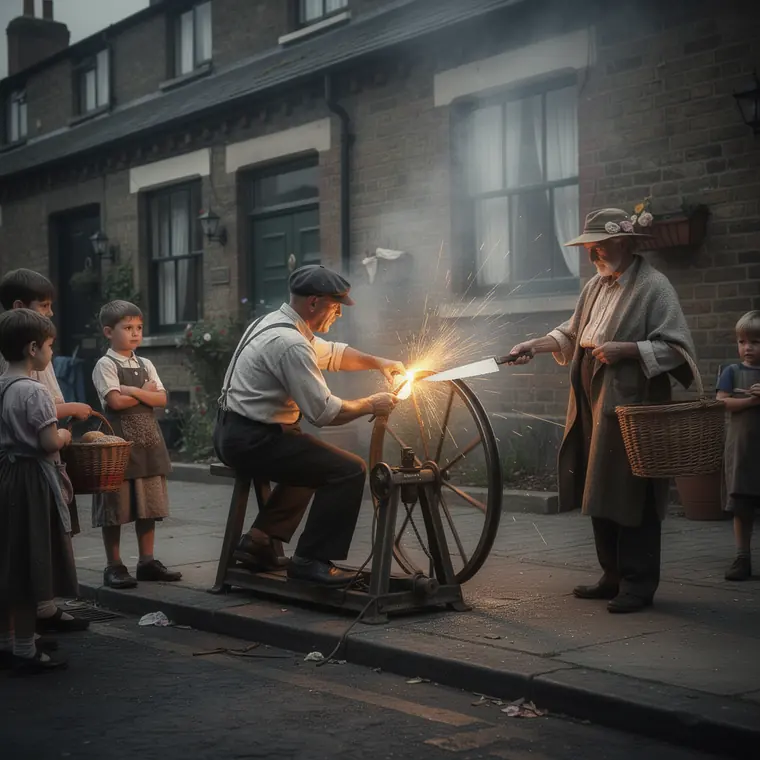
A travelling knife grinder treadling his wheel at a kerb in a street of workers houses, sparks at the blade, children and a hawker with a basket gathering round.
- What it was used for
- On Cullen's account the Sheffield grinder rented his trough in a grinding wheel. In the Grinding Hull at Abbeydale, built in 1817, one waterwheel drove six grindstones and two glazing stones; the stones were six feet in diameter when new and hung in a trough filled with water, the man sitting astride a wooden horsing over the stone. In 1794 there were 83 grinding wheels containing 1,475 troughs and employing 1,800 grinders; a table for 1857 gives 5,029 grinders in and near Sheffield. For 1857 Derek Cullen reports the average ages of the men then living, as established by John Charles Hall: fork grinders 29, table knife grinders 35, saw grinders 38, sickle grinders 40. The stones burst: in 1912 a bursting grindstone in the Abbeydale Grinding Hull killed a scythe grinder.
- What was new
- What was new was not a machine but the statistical proof: a trade broken down by sub-occupation out of death registers. For Solingen, Dr A. Oldendorff worked in 1882 from civil and death registers against two control groups; on the summary the site zeitspurensuche.de draws from his paper, grinders dying above the age of twenty between 1850 and 1874 reached an average of 39.4 years, iron workers 48.3, the rest of the male population 54.4. Cullen names Arnold Knight, in September 1819, as the first to sound the alarm; Engels quoted Knight in 1845 from a text written "ten years ago". The barb is the extraction fan: on Cullen's account it was effective but expensive to install and added to the grinders' cost of renting their troughs, so few used them. Engels claimed in 1845 that the grinders had destroyed it here and there, in the belief that more workers might be attracted to the trade and wages thus reduced; he offers no evidence.
Further reading
- Derek R. Cullen, A Review of the History of Grinders' Asthma in Sheffield, Topics in the History of Medicine Bd. 2 (2022), British Society for the History of Medicine
- Sheffield Museums Trust, Abbeydale Grinding Hull
- Sheffield Museums Trust, Abbeydale Industrial Hamlet: site history
- Historic England, Shepherd Wheel, Sheffield, List Entry 1255068
- Friedrich Engels, The Condition of the Working Class in England (1845), Kap. The Remaining Branches of Industry
- zeitspurensuche.de (Marina Alice Mutz), Schleifer: Mortalität — druckt Oldendorff 1882 und Rosenthal Bd. 2 mit Seitenangaben ab
- Wellcome Collection, Katalogsatz zu John Charles Hall, The trades of Sheffield as influencing life and health (Vortrag 5. Oktober 1865; Druckjahr im Katalog unsicher)