The Works Gate
1890 · Shift Change · Work 392 of 1,871
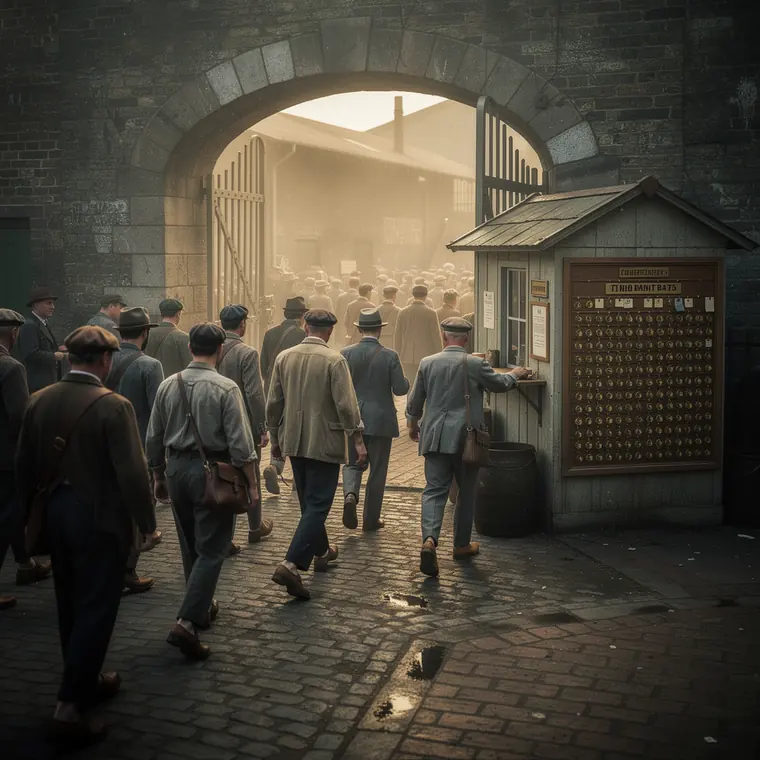
A crowd of workers streaming out through the arched gate of a factory at shift change, clogs on cobbles, a timekeeper hut and a board of numbered brass checks beside it.
- What it was used for
- The works gate was where the counting was done. Willard L. Bundy of Auburn, New York, states the purpose in his own patent (filed 3 August 1887, granted 20 November 1888 as No. 393,205): to compel employees of factories and shops to record at their place of business the time of their entering it, and thus save the extra expense of the watchmen or time-keepers usually employed for that purpose. At German collieries the same work was done by the Markenkontrolle at the entrance: the Fahrmarke, a tin tag with a fixed number, served according to the Förderverein Bergbauhistorischer Stätten for the time and safety control of the miners who had gone below — it also said who was underground. At Swindon a wide entrance gateway flanked by narrow offices led into the Great Western Railway works; the pedestrian subway, about 116 metres long, opened on 5 February 1870, and the listing description gives a workforce of over 14,000 at the peak in 1925.
- What was new
- The core is claim 1 of seven: a clock mechanism with a time-recording type-wheel and a second type-wheel for the operator, worked by keys of different shapes. That is, who and when in one impression, with no witness. Who did it first is a quarrel out of patent litigation: in 1899, in Bundy Mfg. Co. v. Detroit Time-Register Co., the appeal court held that the closest approximation to Bundy's patent in suit of 1891 was also the first in time, namely Lane & Hill (No. 210,788, 1878), and named beside it Haskell, Bundy's own patent of 1888 and Dey's patent of 1889. The barb is double: the machine that made the worker's minute provable was justified in the patent as a saving on the man who had until then stood at the gate. And of the celebrated 1888 patent the same court said that the intricacy and delicacy of the mechanism required made the machine unreliable and of no practical value whatever; the first successful structure of its kind, in its view, was the patent granted 26 May 1891.
Further reading
- US-Patent 393.205, Time-Recorder, Willard L. Bundy (angemeldet 3.8.1887, erteilt 20.11.1888), Volltext-PDF
- Bundy Mfg. Co. v. Detroit Time-Register Co., Court of Appeals for the Sixth Circuit, 2. Mai 1899 (94 F. 524)
- Förderverein Bergbauhistorischer Stätten, Bergmännische Fachbegriffe (Markenkontrolle, Fahrmarke)
- National Heritage List for England 1355905, Former GWR Works entrance and pedestrian subway, Swindon (Spiegel britishlistedbuildings.co.uk; Original historicengland.org.uk war nicht abrufbar)