Sunday Best
1890 · Sunday Promenade · Work 393 of 1,871
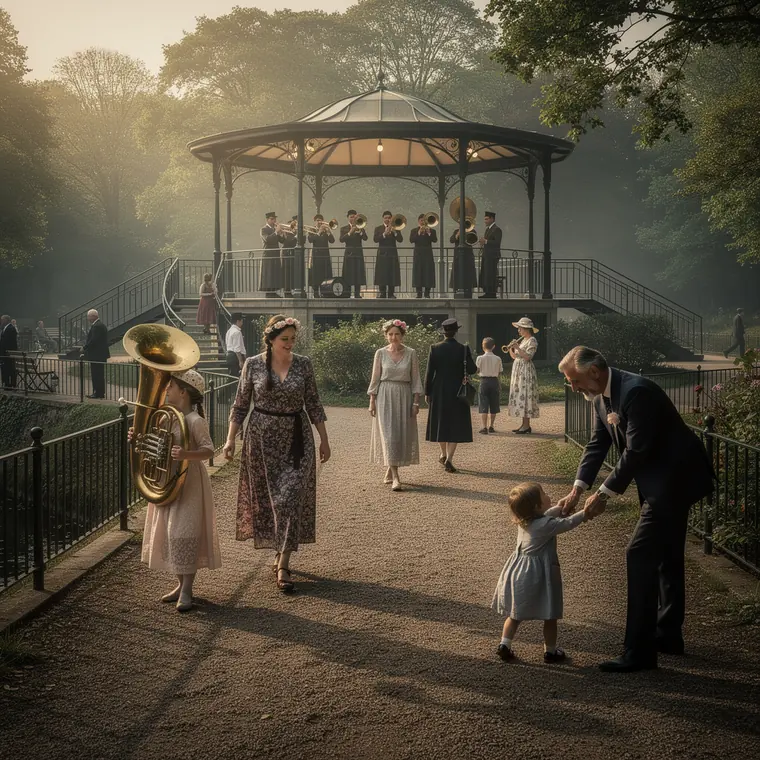
Families in their best clothes walking a park promenade on a Sunday, a brass band on the bandstand, a father steadying a small child on the gravel path.
- What it was used for
- The one good suit, the one good dress — and the pawnshop as the place it was kept. The 1911 Encyclopaedia Britannica reports in its article on Pawnbroking that it was stated in evidence before the Select Committee on Pawnbrokers appointed in 1870 that 207,780,000 pledges had been lodged in the previous year, between thirty and forty millions of them in London; the average value of a pledge appeared to be about 4s, and the proportion pawned dishonestly 1 in 14,000. This is testimony before a committee, not an official count; the source says so itself. The studio portrait belongs with it: according to the National Science and Media Museum, in the 1890s a single portrait at the most fashionable London studios could cost as much as 3 guineas, while the cheapest studios supplied cartes de visite at 2s 6d a dozen. The 1881 England census lists 4,722 entries for 'photographer'.
- What was new
- The Sunday photograph was newly possible; the suit was newly cheap. Why it became cheap cannot be weighed from the sources checked: cheap slop tailoring is attested in London by about 1849, that is, before the sewing machine took hold in men's ready-made trade. What is documented instead is the price others paid: on 9 June 1890 the House of Lords debated the final report of its committee on the sweating system, and on the Earl of Dunraven's account, of 86 witnesses who spoke to the question 83 were of opinion that some or other of the evils they complained of were due to unnecessary middlemen and to sub-contracting. The barb strikes the best-known story itself: Monday in, Saturday out is, for England, largely anecdotal on Sofia Murhem and Göran Ulväng's assessment; where Swedish pawnbooks have been worked through, the rhythm is not weekly but seasonal — coats pawned in spring and redeemed in early autumn. That holds for Sweden, not for Britain.
Further reading
- Encyclopaedia Britannica (11. Aufl. 1911), Artikel Pawnbroking (Transkription des gedruckten Werks bei Wikisource)
- Sofia Murhem / Göran Ulväng, Pawning and pawners in the industrial era: evidence from Sweden, 1870 to 1950, History of Retailing and Consumption (2023), Volltext Universität Uppsala
- National Science and Media Museum, Researching your photographer ancestors
- Hansard, House of Lords, 9 June 1890: The Sweating System
- Henry Mayhew, Labour and the Poor, Morning Chronicle, Letter XVII (14.12.1849), Transkription victorianlondon.org