The Drawing Office
1890 · Drawing Office · Work 395 of 1,871
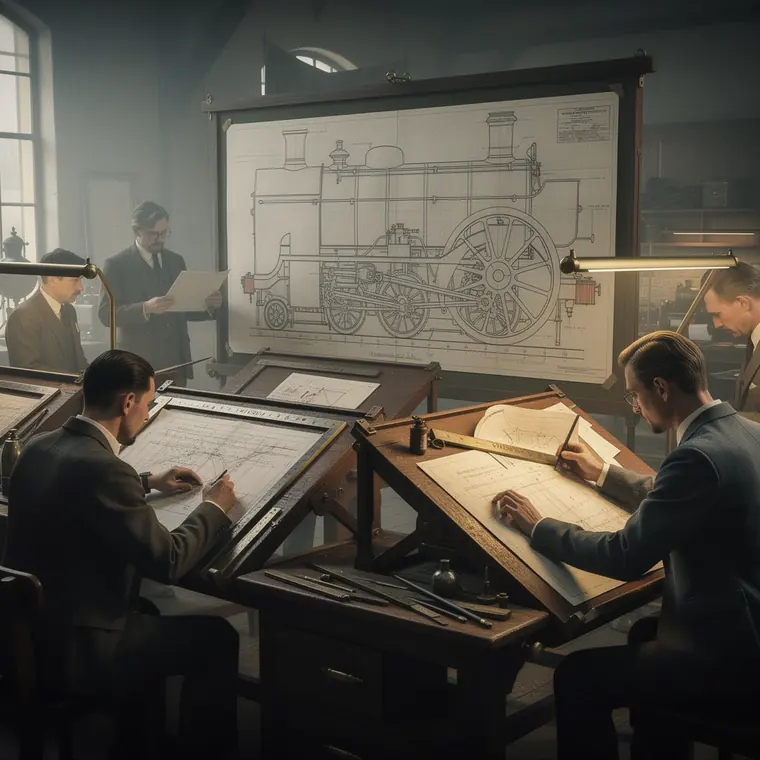
Draughtsmen at rows of sloped drawing boards in a works drawing office, tee squares and section liners in use, a general arrangement of an engine pinned across two boards.
- What it was used for
- The drawing office separated the drawing from the workshop and the fair copy from the design. Lois Olcott Price records that translucent tracing papers and cloths were consciously used as supports for drawings intended for photo-reproduction: in contact printing the tracing lay directly against the glass with the sensitized paper immediately behind it. Portsmouth Dockyard had three drawing offices; the tracers were women and traced the plans to make multiple copies. The Ballast Trust gives up to twenty tracers working in one office at a time and two plan sizes in shipbuilding, 32 and 46 inches; its description of the process, however, rests on an undated recollection by a later tracer, while the dated evidence is a photograph of Fairfield's in Govan, c. 1909. Of the Crewe locomotive works the Science Museum Group holds 188 boxes of drawings, 13 March 1845 to 15 May 1989, listed in six sequences, the main one following the company drawing register.
- What was new
- What was new was not drawing but dimensionally faithful reproduction without redrawing. There is no single starting date: 1842 the chemistry by Herschel, on Price's account expressly not yet developed for commercial use; 1867 the Paris exhibition where a supplier showed the process as cyanotype; 1876 its commercial development, 1877 Henri Pellet's patent; 1891 to 1893 the oldest surviving blueprints in a large architectural archive. There was no national drawing standard in 1890; BS 308 appeared in September 1927. The barb: Chris Valkoinen writes for the National Railway Museum that the tracer's role was highly skilled but perceived to be less technical than the draughtsmen's work, and that the majority of the drawings now surviving in that museum's collections were penned by women and not men. The feminisation of the tracing offices is not documented for 1890; the named cases fall in 1909 and 1947.
Further reading
- Lois Olcott Price, The History and Identification of Photo-Reproductive Processes Used For Architectural Drawings Prior To 1930, Topics in Photographic Preservation Bd. 6 (1995), American Institute for Conservation
- Hetty Berens, Die Einführung der Blaupause, Forschungsprojekt Invented from Copies, Het Nieuwe Instituut Rotterdam
- Chris Valkoinen, Drawing office romance: an engineering love story, National Railway Museum Blog, 11.02.2022
- Sea Your History (Portsmouth Historic Dockyard / Royal Naval Museum), Draughtsmen and tracers
- The Ballast Trust, Women working in Industry: Female Tracers (2018)
- Science Museum Group Collection, Crewe Locomotive Works drawings (188 Kartons, 1845-1989)
- Technical Drawing Standards: A Brief History (BS 308 and all that), cadsetterout.com