The Works Photographer
1895 · Works Photographer · Work 400 of 1,871
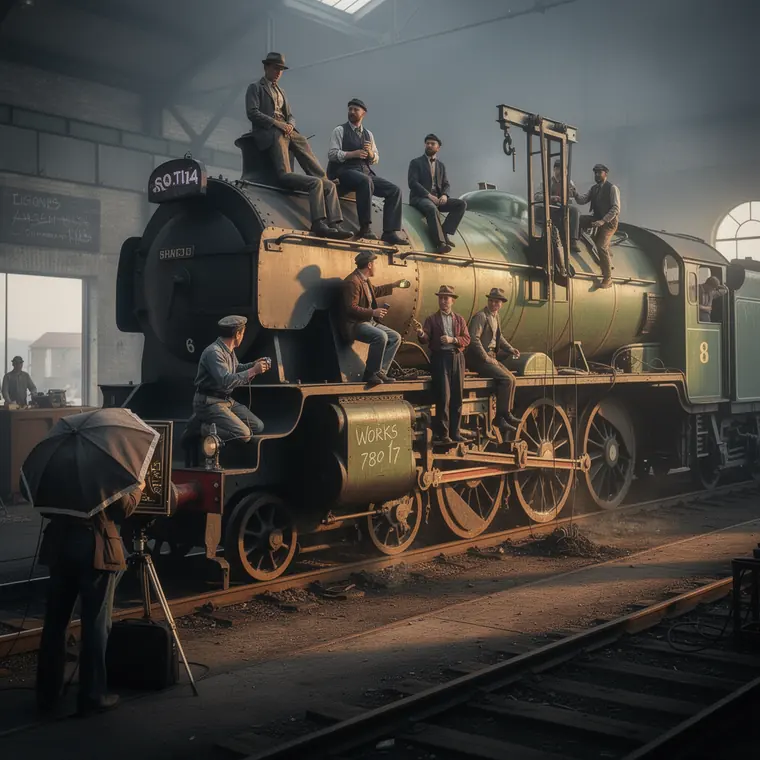
A photographer under his focusing cloth at a plate camera, an erecting gang posed on and around a newly built locomotive, a chalked works number on the frame.
- What it was used for
- Company photographers in locomotive and engineering works. The National Railway Museum's collections guide: "The larger companies, which built their own vehicles, employed photographers to record the construction and refurbishment of engines and rolling stock", covering "every stage in the production process from raw materials to the finished item". The work was done on glass negatives "usually between 8½ x 6½ and 16 x 12 ins."; the pictures were reproduced in company brochures or sold as postcards to customers and collectors. Much survives: over 2,500 works photographs in the Beyer, Peacock archive at the Science and Industry Museum, some 9,000 glass negatives and 6,500 prints of the North British Locomotive Company, and about 28,500 negatives for Derby Works alone.
- What was new
- What was new was not photography but what the gelatin dry plate made possible inside the works — introduced by R. L. Maddox in 1871 and in general manufacture from 1878, according to the National Science and Media Museum. The photographer no longer had to coat the plate immediately before the exposure and develop it at once; he could carry bought, keepable plates into the shop, out into the yard and to the customer. With it came the standard: "typically in broadside views, with the backgrounds blanked out with retouching ink." That made engines of different years comparable in one picture format — and it means the documentation that served as evidence was altered by design. Anyone reading these broadside views today as a source on factory life is reading a picture with the factory retouched out of it.