Schickard's Calculating Clock
1623 · Rechenuhr · Work 401 of 1,871
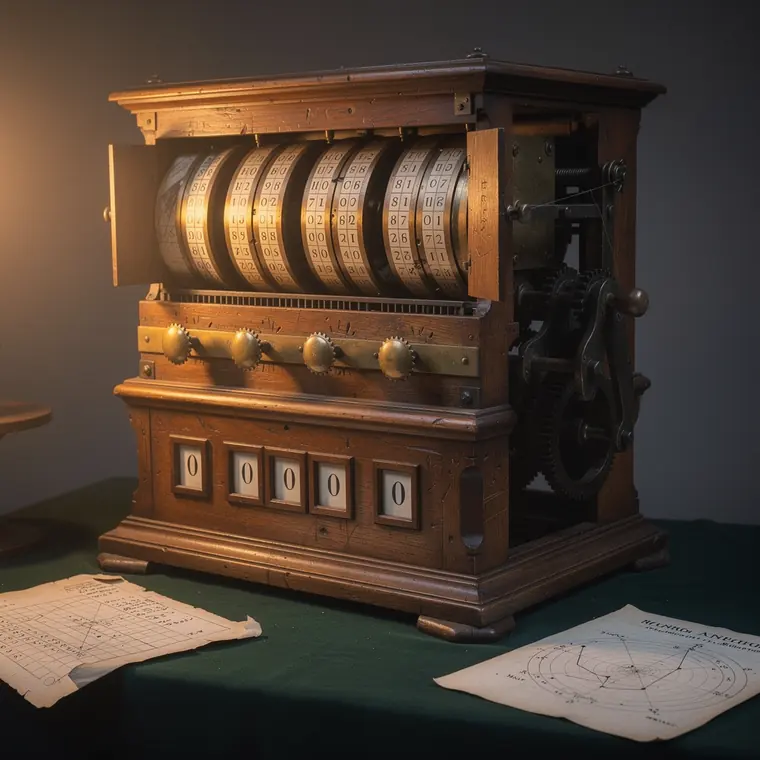
A wooden calculating machine of the early seventeenth century built as an upright oak cabinet, six cylinders standing side by side in the upper half, each cylinder carrying ruled columns of small squares in the manner of Napier's rods, sliding wooden shutters over the cylinders, a row of toothed brass setting knobs in a line across the middle, a lower register of six small square windows, the numeral windows show exactly 0 0 0 0 0 0, one digit per window, iron gearing visible through an open side panel, every other surface plain oiled oak, standing on a dark baize-covered table before a deep neutral background, a single raking light from the left catching the brass knobs and the worn wood grain.
- What it was used for
- Wilhelm Schickard, professor at Tübingen, built two examples: one for himself, one for the astronomer Johannes Kepler and his computing work. In his letter to Kepler of 20 September 1623 (date of the letter) he describes a machine made of eleven complete and six mutilated toothed wheels. The Arithmeum gives its capacity as six digits in the setting, revolution and result registers; the University of Tübingen notes that the machine could calculate "only" in the six-figure range. Kepler's was half-finished when it burned; no calculation actually carried out on an original is documented.
- What was new
- The Arithmeum calls it the first calculating machine in the world with a mechanical tens carry — a museum's formulation, and it applies only to the lower part: the automatic carry sat in the adding mechanism, while multiplication ran semi-mechanically on six rotatable cylinders carrying a variant of Napier's rods, that is on a reading aid and not on a calculating mechanism. Whether the original carried reliably is not documented – Schickard complained of imprecisely made teeth; of Bruno von Freytag-Löringhoff's series of reconstructions the HNF writes that every one of them works. The barb is its ineffectiveness. Kepler's machine burned three days before Schickard's letter of 25 February 1624. Franz Hammer found the sketches in 1935, they became known in 1957, the first reconstruction was built in 1960. Until then the Pascaline was regarded as the first true calculating machine; Schickard's was mentioned only in passing as a curiosity.