Poleni's Calculating Machine
1709 · Wooden Pinwheel · Work 404 of 1,871
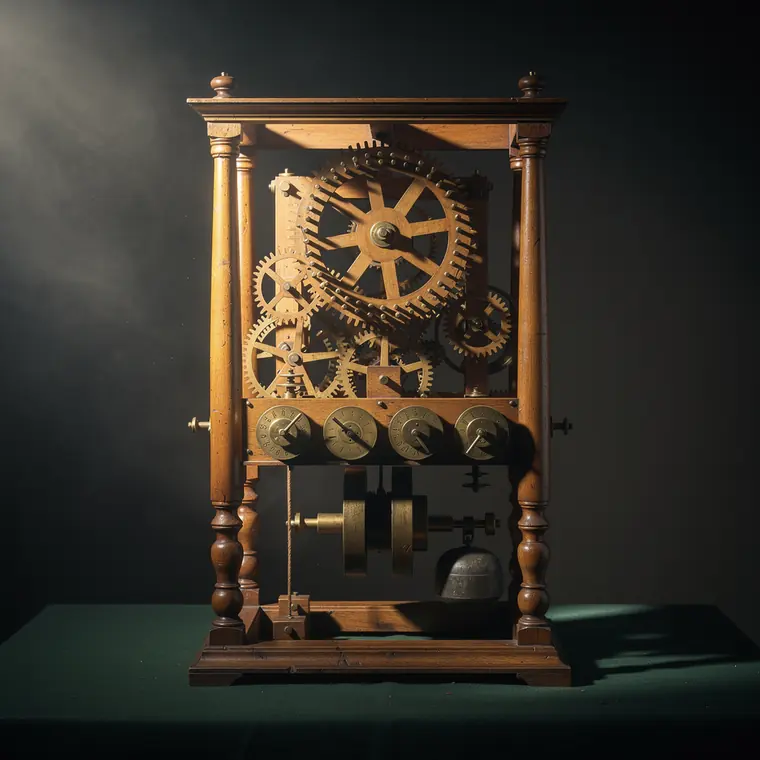
A tall calculating machine built entirely of wood, a vertical open frame taller than a man's chest carrying large toothed wheels with movable pegs set into their rims, the largest wheel at the centre with its rim studded by a ring of pegs, a weight on a cord hanging down one side to drive the mechanism through a wooden drum, turned wooden columns at the four corners, smaller dial wheels with plain faces on the front, every surface plain turned and planed walnut, standing on a dark baize-covered table before a deep neutral background, a single raking light from the left throwing long shadows from the pegs across the wheel faces.
- What it was used for
- Giovanni Poleni, professor at Padua, built the machine "in wood and iron" according to Silvio Hénin, in the shape of a large longcase clock; a clockwork with a verge escapement drove it by the energy of a falling weight. No practical use is documented; according to Hénin a three-sector wheel allowed a three-digit figure to be set. Poleni described it himself in his "Miscellanea", Padua 1709 (publication). It became known in Europe only through Jacob Leupold's survey of mathematical instruments of 1727 — eighteen years after his own account.
- What was new
- The pinwheel: according to Hénin "a wheel with an adjustable number of teeth (0-9) that could be raised or lowered to set the figure to be operated upon". The difference from Leibniz lies in the construction — the stepped drum carried fixed, graduated rows of teeth, while Poleni's wheel set the digit by moving its teeth in and out. According to Hénin it was used, in other designs, over the next three centuries, e.g. in the Baldwin-Odhner type. Poleni was not the first at calculating, and the idea is older: the HNF shows a 1672 drawing from Leibniz's Paris circle with retractable teeth. Poleni built it into a real machine — and destroyed that machine himself: his biographer Grandjean de Fouchy reports in 1763 (Éloge, pp. 152-153, cited by Hénin) that Poleni smashed his machine and never built it again after learning of a similar but better machine built by Anton Braun in Vienna. Hénin reports it with attribution to the biographers, not as his own finding.