Hahn's Calculating Machine
1774 · Circular Stepped Drum · Work 405 of 1,871
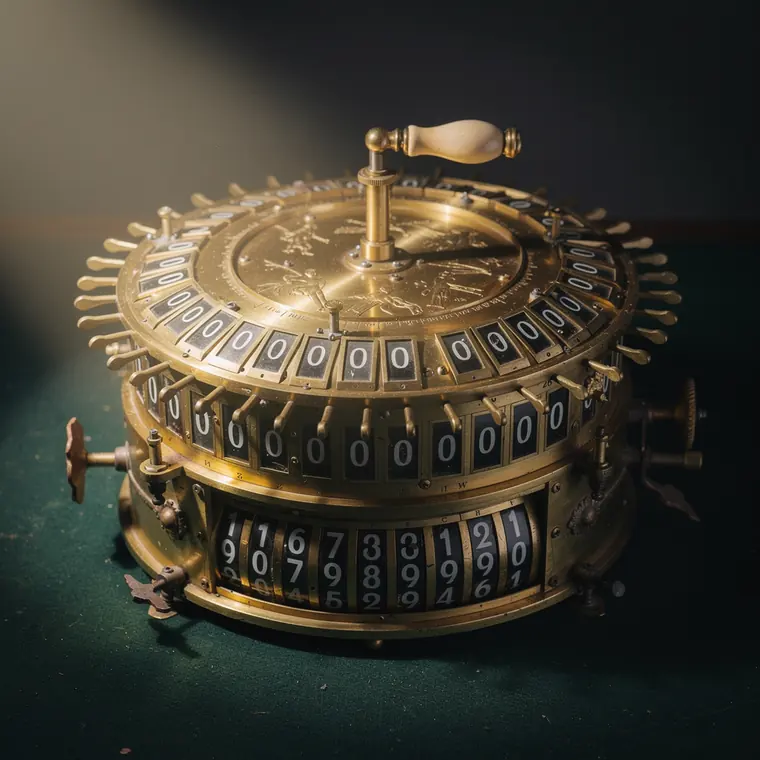
A drum-shaped calculating machine of polished brass, circular in plan like a large pocket watch laid flat, its upper face a ring of small numeral windows around the rim, each window showing the single digit 0, setting levers arranged radially around the outer edge like the hour marks of a clock, a crank rising from the centre with a turned ivory grip, a lower tier of the drum showing a second ring of windows, every other surface plain polished brass with a soft mirror sheen, standing on a dark baize-covered table before a deep neutral background, a single raking light from the left sweeping across the curved brass flank.
- What it was used for
- Philipp Matthäus Hahn, parson at Kornwestheim and later Echterdingen, built calculating machines in his workshop alongside astronomical clocks and planetary machines. The Landesmuseum Württemberg describes an eleven-digit machine with a setting register, setting rods, coupled stepped drums and a central crank, made 1770-1774; the Arithmeum counts over 1,260 parts in its replica, 733 of them made by hand. According to Erhard Anthes the eleven-digit machine went to the Duke of Württemberg. Two originals survive according to the computer museum of the University of Stuttgart, in the Landesmuseum Württemberg and in the Technoseum at Mannheim.
- What was new
- The drums stood in a circle, not in a row. The HNF describes the machine as drum-shaped, 26.5 centimetres across and eleven centimetres high, with the stepped drums standing upright in a circle: radially around a central crank, so that it was compact and could be worked over all places from one crank. The Stuttgart computer museum calls it the first four-function calculating machine fully operable across all places — a museum's verdict, and Michael Wright claims the first wholly automatic tens carry for Stanhope's machine of 1777, so priority is not settled. In 1779 Hahn published a description of a calculating machine in the Teutscher Merkur, by his own title made "in the year 1777 and 78" — but according to the HNF he described only the handling and said nothing about the internal construction. The Stuttgart computer museum, however, says it describes the stepped-drum construction. There was never a production run.
Further reading
- Landesmuseum Württemberg über die Deutsche Digitale Bibliothek: Rechenmaschine von Philipp Matthäus Hahn
- Arithmeum, Universität Bonn: Hahn I, Objekt 1708
- Computermuseum der Universität Stuttgart: Rechenmaschine Philipp Matthäus Hahn
- Erhard Anthes: Philipp Matthäus Hahn, Konstrukteur und Hersteller von Instrumenten (PDF)
- HNF-Blog: Als die Rechenmaschinen rund waren