The Stanhope Calculator
1775 · Stanhope Mechanism · Work 406 of 1,871
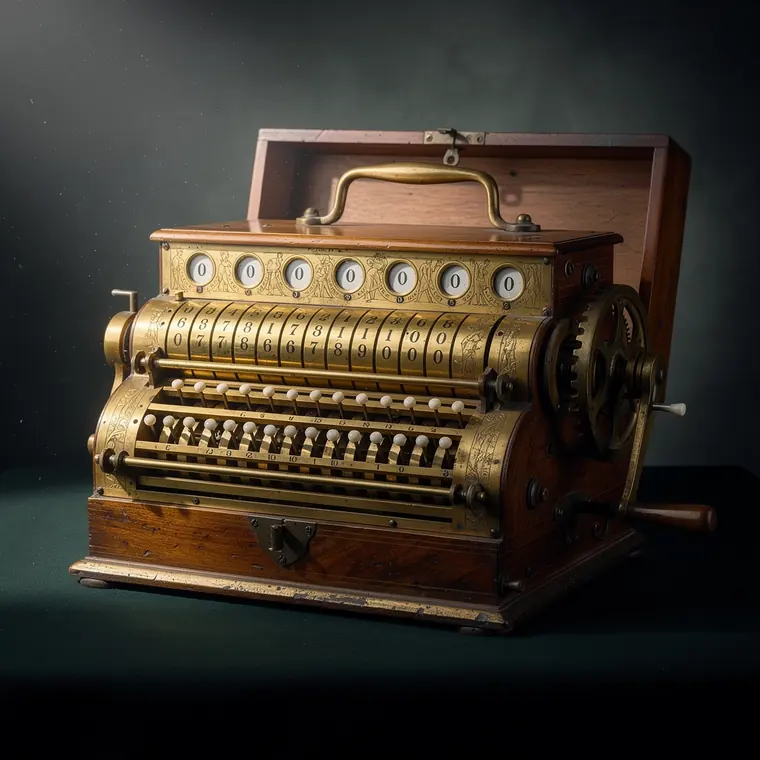
A rectangular calculating machine in a case of mahogany and brass, a row of small round numeral windows across the upper brass face, each window showing the single digit 0, sliding setting bars below them in parallel slots with small ivory pointers, a crank on the right side, a brass carrying handle on the lid, every other surface plain brass and figured mahogany, standing on a dark baize-covered table before a deep neutral background, a single raking light from the left raking across the slots of the setting bars.
- What it was used for
- Charles Stanhope, 3rd Earl Stanhope, signed as Viscount Mahon; the machines were made by James Bullock in London; according to Martyn Downer Stanhope never sought financial reward for any of his inventions. There are three different machines, to be kept apart. Four-function machines of 1775 and 1777 — the Science Museum records the second as "Calculating machine invented by Charles Stanhope in 1777, made by James Bullock", inv. 1872-137, "Known as the Leibniz type". Separate from these, a coplanar toothed-disc adding machine of 1780, twelve-digit and, according to the Arithmeum, set up for English currency "from 'Farthings' to 'Hundred Million'", inscribed "Visc[oun]t Mahon Inv[enit] 1780 Ja[me]s Bullock Fecit"; the original is in the Old Ashmolean at Oxford.
- What was new
- Here the entry stays thin, and that is the finding. One constructional feature of the 1780 machine is documented: according to the Arithmeum Stanhope avoided intermediate gears, which makes the result displays turn in alternating directions. For the 1777 machine a fully automatic tens carry is claimed; the analysis is Michael Wright's, printed by Martyn Downer, who exhibited the machine in 2008, as his contribution to the exhibition catalogue. The barb is what survives: Downer names three surviving examples, one of them only a fragment, and the Science Museum holds, beside the machine, a "small trial piece". Both pieces reached the museum through H. P. Babbage and, according to Wright, had belonged to Charles Babbage — Stanhope's machines became collection items of the next generation of calculating machines rather than tools of their own.
Further reading
- Science Museum Group Collection: Calculating machine invented by Charles Stanhope in 1777, made by James Bullock (Inv. 1872-137)
- Science Museum Group Collection: Small trial piece for calculating machine invented by Charles Stanhope in 1777 (Inv. 1905-148)
- Arithmeum, Universität Bonn: Coplanar toothed disk adding machine by Charles Stanhope from 1780
- Martyn Downer: The Earl's Machine (Ausstellungstext 2008 mit Beitrag von Michael Wright)