The Bureau du Cadastre
1793 · Human Computation · Work 407 of 1,871
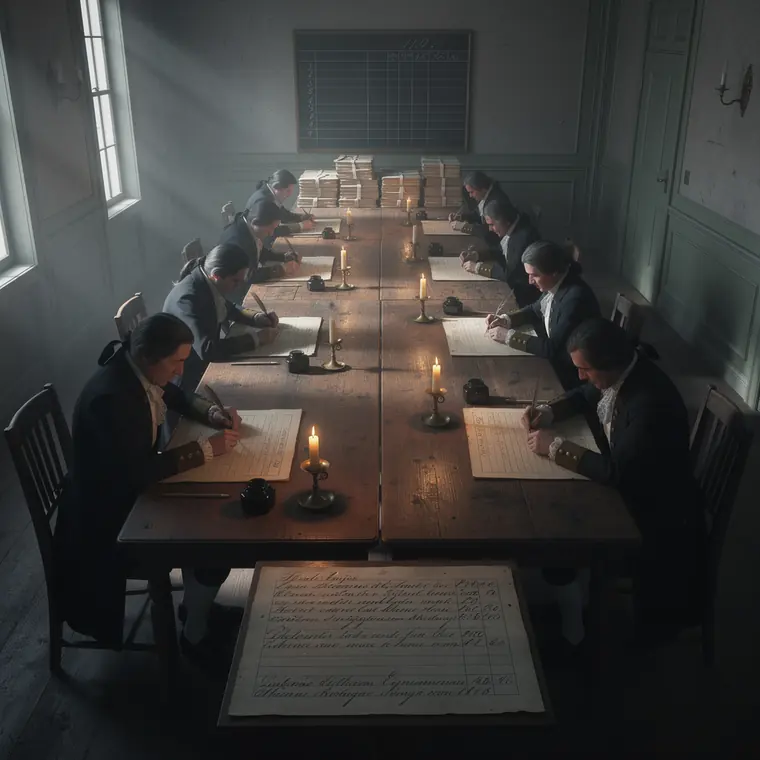
A long panelled room of the 1790s with clerks seated at plain deal tables in two ranks, each place holding one blank ruled ledger sheet, a quill and an inkwell, every clerk performing the same written operation, bundles of finished ruled sheets tied with tape and stacked at the far end, a slate on the wall chalked with ruled columns, the clerks in dark coats and white stocks seen from behind or bent over their sheets with faces in shadow, daylight from tall sash windows along one wall, a single tallow candle in a brass holder on each table, bare boards and plaster walls, cool grey daylight against the warm candle flames.
- What it was used for
- From 1793 Gaspard de Prony had logarithmic and trigonometric tables computed at the Bureau du Cadastre for the centesimal division of the quadrant; among other things the logarithms of the first 200,000 numbers to at least fourteen places. Lorraine Daston, following Prony, gives three tiers: a handful of mathematicians, among them Legendre, the only one Prony names according to Roegel; below them seven or eight "calculateurs" trained in analysis; and at the base "seventy or eighty persons ... knowing only the rudiments of arithmetic". Prony's own statement of 1801 was, according to Roegel, sixty or eighty, and in 1832 he gave 150 to 200; the payrolls for Frimaire IV (1795) name eighteen computers and verifiers, and Denis Roegel estimates there were never more than twenty or twenty-five. That unemployed hairdressers were among them was apparently first mentioned by Charles Dupin in 1824; Prony seems never to mention them, and Roegel suggests there were perhaps only two or three.
- What was new
- What was new was the division of labour: mathematical insight was separated from arithmetical work, so that the lowest tier merely added and subtracted along a difference scheme and no longer needed to know any mathematics. According to Daston's rendering of his Notice sur les grandes tables (1824), Prony invoked Adam Smith and wanted his logarithms manufactured the way pins are manufactured. They were never printed. By December 1795, 527 pages had been set, Roegel records, and then the collapse of the assignat made printing unaffordable; the Cadastre was abolished on 24 March 1802, and the printer Didot kept the plates for nearly forty years. The joint British-French attempt at printing, 1819 to 1824, failed according to Roegel probably mainly because the British side wanted the tables converted to the sexagesimal division — which would have meant redoing every computation. The centesimal division, the reason for the work, thus also stood in the way of its publication.
Further reading
- Denis Roegel: The great logarithmic and trigonometric tables of the French Cadastre - a preliminary investigation (LOCOMAT, LORIA/INRIA)
- Lorraine Daston: Enlightenment Calculations, Critical Inquiry 21 (1994) 182-202
- Jean-Louis Peaucelle: Un « éléphant blanc » en pleine Révolution française : les grandes tables de logarithmes de Prony comme substitut au cadastre ! (Gérer et Comprendre 107, März 2012)