The Calculating Room
1900 · Arithmometer · Work 415 of 1,871
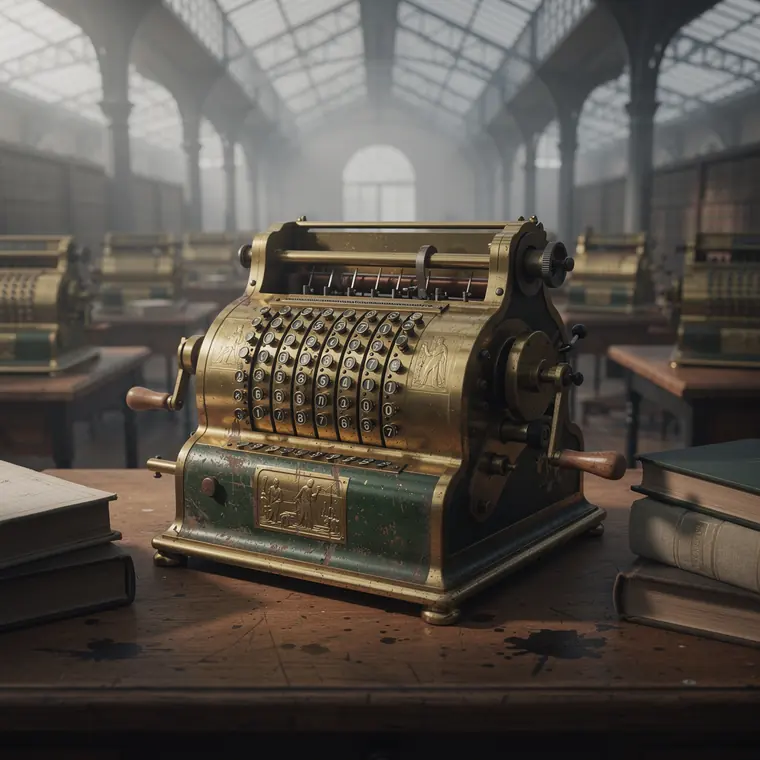
An immense clerical hall beneath an iron and glass roof, hundreds of identical oak desks in ranks running to the far wall, one brass calculating machine at every place, clerks in shirtsleeves with sleeve garters seen from behind, bent over their machines with faces turned down, bound ledgers with plain cloth spines stacked along the aisles, cast iron columns marching down the hall, cool daylight falling through the glass roof onto the rows of brass machines, the far end fading into grey haze, warm brass glints against desaturated grey.
- What it was used for
- A room in which people did the calculating, before machines did. At the Royal Observatory Greenwich the post existed from 1836 to 1937; the job was to reduce observations, that is to compute them into a standard form. Early on the computers worked from home; from the 1830s the work moved into the observatory itself, first into the Octagon Room of Flamsteed House. In 1841 there were 12 computers, in 1842 fourteen; in 1935-36 still 16 temporary ones. Soon after 1842 they were selected by competitive examination among 13 and 14 year olds from local schools; a boy computer of the 1890s was paid 3 pounds a month. Human computers, though with different staff and tasks, also worked at the Harvard College Observatory: there, on the American Museum of Natural History's account, some 80 women worked for 25 to 50 cents an hour, six days a week.
- What was new
- Nothing was invented here; what was new was the division of labour. The Royal Observatory Greenwich account records that already for the Nautical Almanac computers of Maskelyne's time astronomical knowledge was not regarded as essential - what was wanted was literacy and numeracy, the handling of tables, attention to detail and neatness. The price was written into the rules: after 1872 promotion examinations were restricted to ages 18 to 25, so a computer not promoted by 26 had no prospect of a permanent post. The four lady computers Christie appointed in 1890 were paid the same as the boys but had to find their own lodgings; by the end of 1895 none remained.