Britannia Bridge
1850 · Wrought Iron Tubular Girder · Work 42 of 1,871
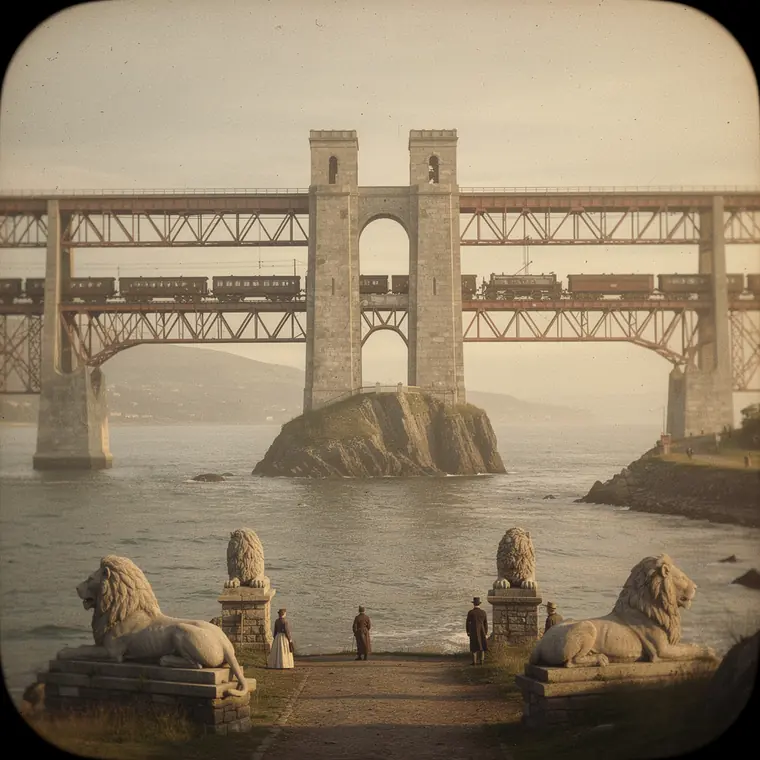
Robert Stephenson's Britannia Bridge on the Menai Strait: two long rectangular iron tubes lying side by side like two enormous closed boxes of riveted plate, their sides solid sheet iron from top to bottom without any opening, the trains running inside the tubes and completely hidden, only smoke drifting from the tube ends, the tubes running straight and level through openings in three tall limestone towers that rise above them, the centre tower standing on the rock in mid-strait, a shorter shore span at each end, four couchant limestone lions guarding the approaches, two at each end.
- What it was used for
- A railway bridge of the Chester and Holyhead Railway across the Menai Strait; Stephenson drove the last rivet on 5 March 1850. Its purpose was through running from London to Holyhead, and with it the sea link to Dublin. Each of the two tracks ran inside its own closed wrought iron box tube; the Admiralty demanded clear passage for sailing ships, at least 100 feet above high water and no falsework in the channel. Trains ran inside the tubes for 120 years.
- What was new
- What was new was not the box girder as such but its depth: the girder was deep enough for the train to run inside it rather than on or under it. The design rested not on experience but on destructive and buckling tests on models, including a 23 m model at Fairbairn's Millwall yard. The two consultants disagreed: Hodgkinson wanted auxiliary chains, Fairbairn thought them unnecessary. Stephenson followed Fairbairn - but the towers had already been built to take the chains, and above today's road deck they have had no function since.