The Macaroni Box
1885 · Key-Driven Prototype · Work 422 of 1,871
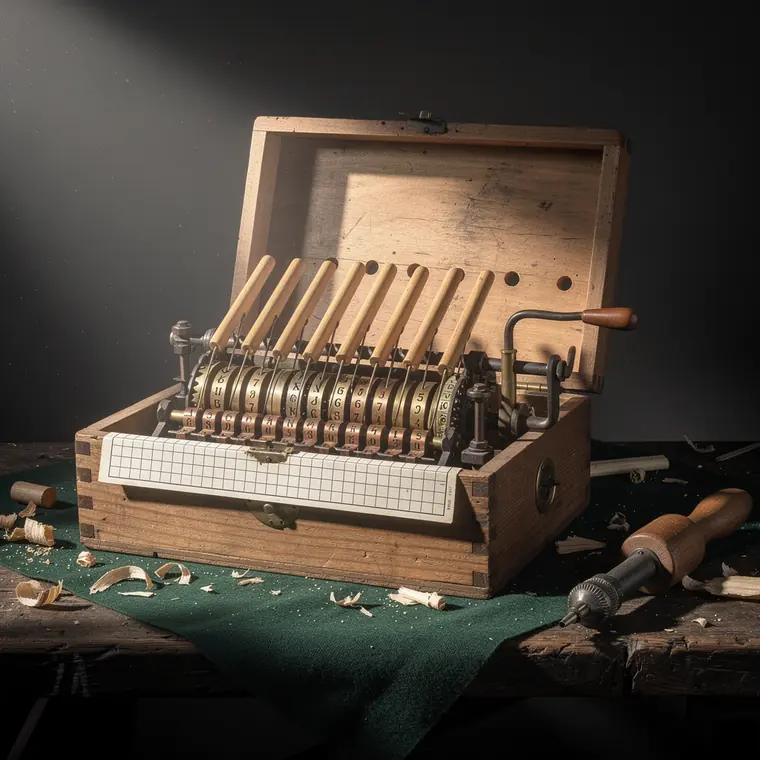
A calculating machine built inside a plain wooden grocery box, wooden meat skewers serving as key levers protruding in ranks through holes bored in the lid, staples and rubber bands holding the mechanism inside, a paper strip ruled into small squares glued along one edge of the lid, the box lid propped open to show the crude mechanism, the wood raw and unfinished, standing on a dark baize-covered table before a deep neutral background, a single raking light from the left raking across the rows of skewers.
- What it was used for
- Dorr E. Felt's first crude model of a key-driven adding machine, built in Chicago. In his 1916 lecture Felt describes the shopping: a macaroni box from the grocer for the frame, skewers from the butcher for the key stems, staples from the hardware store, rubber bands from the bookshop to serve as springs. He began on Thanksgiving Day because it was a holiday, and worked on Christmas and New Year's Day as well. The Smithsonian, which holds Felt's collection of machines, names a grocer's macaroni box with meat skewers for key stems. Out of the wooden box came the Comptometer; the firm Felt founded with his backer Robert Tarrant lasted until the merger with Victor in 1961.
- What was new
- Not the full keyboard. The Smithsonian records that the Unitarian minister and mathematician Thomas Hill had patented an adding machine with a column of keys per digit almost thirty years earlier, but that it never became commercially viable. What was new in Felt's box was what it demonstrated: that one press of a key sets the digit and enters it in the register at the same time, with no intermediate step. The barb is in the consequence. The box of groceries and hardware cost almost nothing; the machine that came out of it then required trained staff, and from 1905 Felt & Tarrant set up its own Comptometer schools.