Sundstrand Ten-Key
1914 · Ten-Key Adding · Work 425 of 1,871
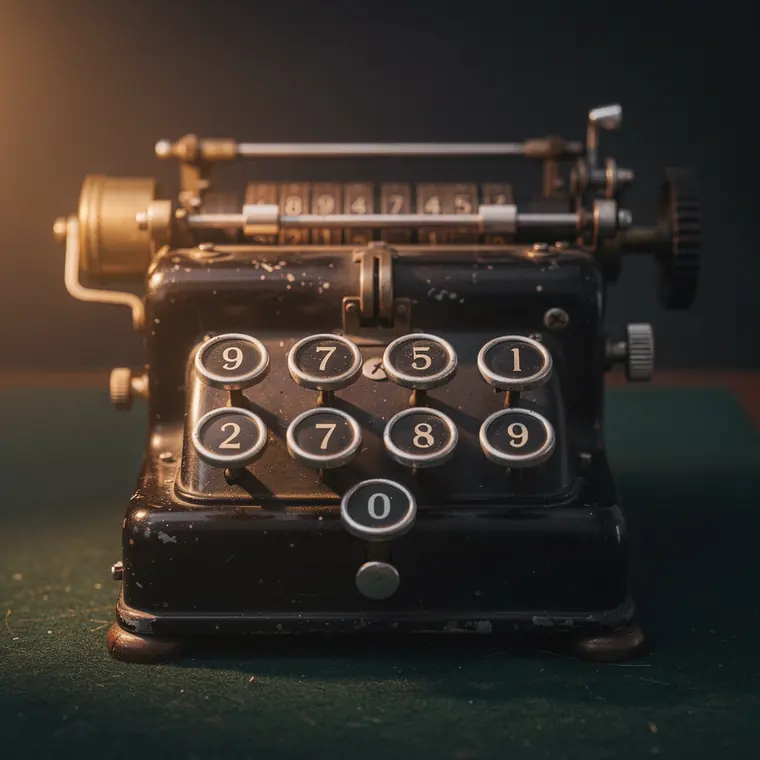
An adding machine with ten keys laid out in three rows of three with a single key below, each key cap bearing exactly one digit from 0 to 9, the compact ten-key block set in the middle of a black enamelled body, a printing head and paper roll behind, a crank with a wooden grip on the right, every other surface plain black enamel and nickel, standing on a dark baize-covered table before a deep neutral background, a single raking light from the left raking across the ten-key block.
- What it was used for
- A printing adding machine with ten number keys instead of a full keyboard, built in Rockford, Illinois. The patent "Adding and Listing Machine", US 1,198,487, was filed on 14 March 1914 and granted on 19 September 1916; the inventor named is Gustaf David Sundstrand and the assignee is the Rockford Milling Machine Co. The specification states as its aims, among other things, automatic subtotals on a ten-key machine and better means of printing items and totals in contrasting colours, described as blue for items and red for totals; the machine works to 999,999,999 over nine vertical type bars. In 1927 the brothers handed distribution to Underwood-Elliott Fisher.
- What was new
- Not the ten-key board. The Smithsonian lists the forerunners: Jean-Baptiste Schwilgué patented such a device in 1844, Victor Schilt showed one at the Crystal Palace in 1851, and the Standard adding machine of Ludlum and Hopkins was, on the Smithsonian's account, from 1903 in St Louis the first widely distributed ten-key adding machine on which the printed figures were visible. What was new was the arrangement of the ten keys: the Smithsonian credits Sundstrand with the 3 x 3 pattern and a zero bar beneath it, and calls it the standard for adding machines and later for electronic calculators. Which brother designed it is disputed: the Science Museum names Oscar Sundstrand as the maker of a hand-built machine of about 1913, and the Smithsonian also names Oscar, whereas Retrocalculators names David; the 1914 patent, which concerns subtotals and colour printing, names Gustaf David.