Comptometer Model H
1926 · Key-Driven · Work 426 of 1,871
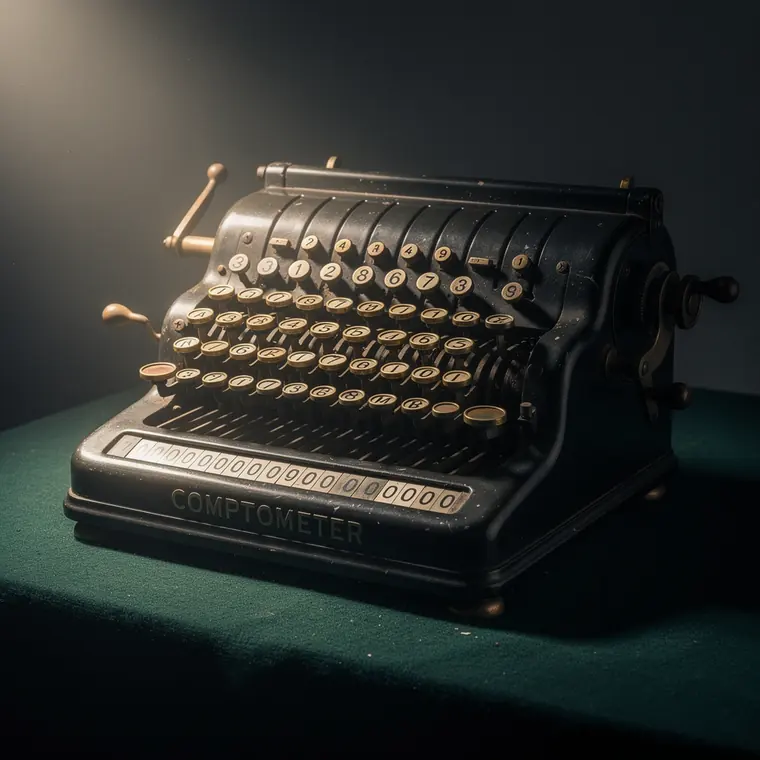
A key-driven calculating machine in a moulded case with a smooth dark finish, the stepped key bank with rounded contours, columns of round keys rising from front to back, each key cap bearing exactly one digit from 1 to 9, controls reduced to two small levers at the sides, a slim result strip at the front, each window in the strip showing the single digit 0, every other surface plain dark moulding, the name across the front reading "Comptometer", standing on a dark baize-covered table before a deep neutral background, a single raking light from the left raking across the rounded key bank.
- What it was used for
- A key-driven adding machine by Felt & Tarrant of Chicago, built from 1920 on John Wolff's account. Two changes are documented: a large part of the tens-carry mechanism was moved into a removable rock frame, and the machine gained a triple "start from clear" signal - visible, audible and tactile - so that nothing was added onto a leftover total. The controlled key had already been introduced in the Model E of 1913. The machine was worked by specially trained staff: on John Wolff's account there were Comptometer schools from 1905, over 100 in the United States by the late 1920s and some 50 abroad, turning out by his figure around 20,000 operators a year, recruited from school leavers of about sixteen.
- What was new
- Not the calculating but the prevention of error and the servicing: the triple start-from-clear signal and the removable rock frame. The controlled key had already been introduced in the Model E of 1913. The year does not quite belong to the thing either: John Wolff dates the Model H to 1920 and its successor J to 1926, the J differing essentially only in carry gear, escapement levers, springs and keytops - so 1926 marks the change of model, not the Model H. The barb is in the training: the Smithsonian records of the Comptometer Educator that operators were trained to use only the first five, lower keys of each column. Nine keys to a column, four of which the trained operator was taught not to use. The occupation declined from the late 1960s, as larger firms moved to computers.
Connections
Every connection names its kind. “Forerunner” on its own would be a claim.
- Follows fromComptometer Model A1904Both are Felt & Tarrant Comptometers: the Model A, made from January 1904, was the firm's first 'duplex' machine; according to the Smithsonian the Model H succeeded the Model F in 1920. The firm steadily improved, but did not radically alter, the product.Source: Smithsonian NMAH, Adding Machines: Full-Keyboard - Hill to Felt & Tarrant