Verea Direct Multiplier
1878 · Multiplication Cylinder · Work 427 of 1,871
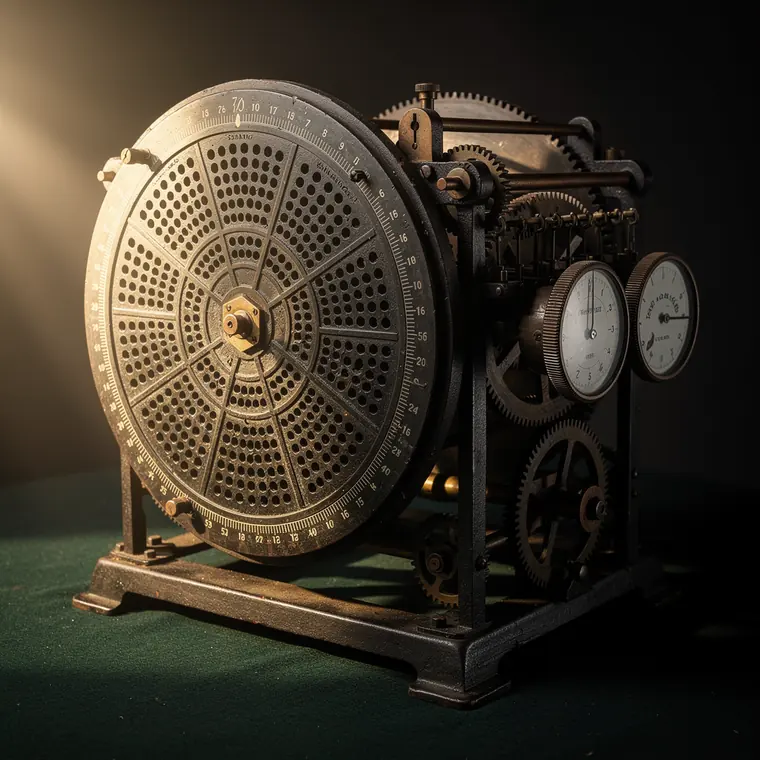
A calculating machine dominated by a large metal cylinder pierced with rows of holes of differing depths, the pattern of holes forming a physical multiplication table around the drum, setting dials with plain faces on a plate beside the cylinder, the whole in a plain iron frame with exposed gears, every other surface plain dark iron, standing on a dark baize-covered table before a deep neutral background, a single raking light from the left raking across the pierced cylinder so each hole throws its own shadow.
- What it was used for
- Ramón Verea worked on a Spanish-language newspaper in New York and traded Spanish gold and banknotes; that got him interested in calculation. No use in any business is documented. The Smithsonian records of its example that it did not become a commercial product. It was built as a proof, and as a proof it won a gold medal at a Cuban exhibition. According to Peggy Kidwell (Rittenhouse 9/2, February 1995), as retold by John Lienhard in Engines of Our Ingenuity, Verea never tried to market it: he walked away and invented nothing else.
- What was new
- It multiplied a number by a digit directly instead of by repeated addition. The multiplication table sits physically inside the machine: upright prisms carry holes of varying depth, tapered pins feel the depth, racks and pinions pass the value to the result wheels. The difference from Thomas's arithmometer is labour: there each digit of the multiplier needs as many crank turns as its value, here a lever setting and one turn of the crank per digit do it. Not even the Smithsonian claims priority for it; its wording is "one of the first" machines of this kind. Selling, Bollée and Steiger later solved the same problem by other mechanical means. Patent US 207918 was granted on 10 September 1878; the patent text was not consulted.
Connections
Every connection names its kind. “Forerunner” on its own would be a claim.
- Parallel toBollée's Multiplication Machine1889Both multiply directly rather than by repeated addition: Verea in 1878 with two ten-sided brass prisms whose holes represent the multiples of a digit (US patent 207918), Bollée in 1888 with multiplication bodies whose rows of pins represent the multiples of the digits 1 to 9. Verea's machine was never produced; the sources name no link between the two.Source: Smithsonian NMAH, Bollée Calculating Machine (nennt Vereas Patent von 1878 und dass es nie gebaut wurde) · Smithsonian NMAH, Verea Calculating Machine Model · Smithsonian, Calculating Machines: Direct Multiplication Calculating Machines