Selling's Calculating Machine
1886 · Lazy-Tongs Linkage · Work 428 of 1,871
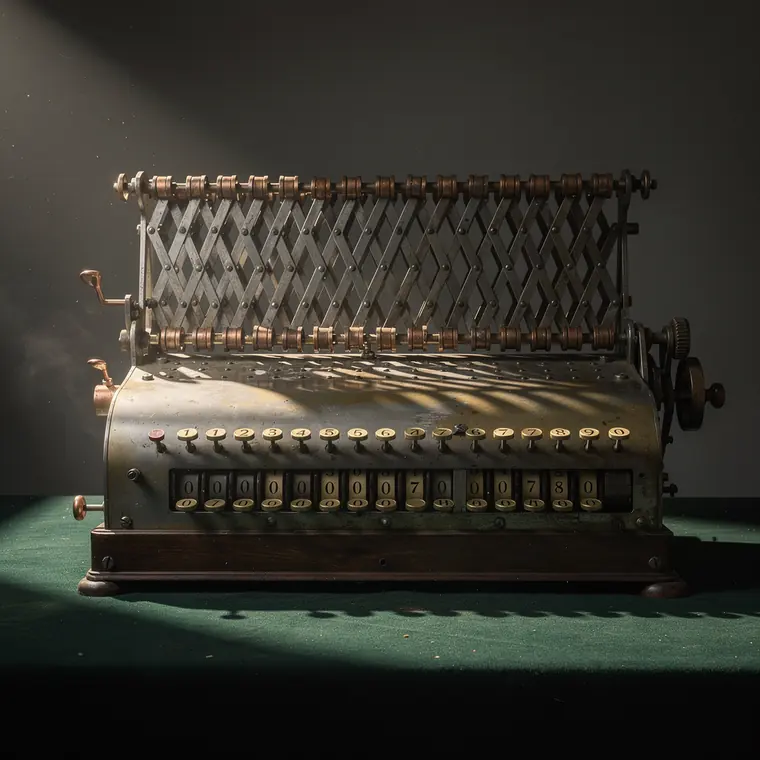
A calculating machine driven by a lazy-tongs linkage, a long diamond lattice of hinged steel bars extending and contracting along the top of the case, the lattice the dominant form across the full width, setting keys arranged in a row beneath the lattice, each key cap bearing exactly one digit from 0 to 9, a row of numeral windows at the front, each window showing the single digit 0, every other surface plain steel and dark wood, standing on a dark baize-covered table before a deep neutral background, a single raking light from the left throwing the lattice's diamond shadows across the case.
- What it was used for
- Eduard Selling was an associate professor of mathematics at Würzburg and computed annuity tables; the machine came out of insurance mathematics. In his 1887 pamphlet he named his intended customers: banks, state administrations, scientific institutions, merchants and administrative offices — that is intent, not evidence, and no buyer is documented by name. It was made and sold by Max Ott's mathematical-mechanical institute in Munich and Würzburg. According to Stephan Weiss about thirty were built, at 400 Mark each, and two survive: in the Deutsches Museum and the Braunschweigisches Landesmuseum.
- What was new
- The multiplying mechanism is a lazy-tongs linkage: each partial product appears as a length of travel in one movement, instead of repeated cranking as on the Thomas machine. Added to that were key entry instead of setting slides, and a creeping tens carry through planetary gears instead of a jerky one. The maker, Max Ott, stated the price of that himself in the 1892 exhibition catalogue: because the carry runs continuously, the result digits do not sit at the index line but are advanced by tenths. In the supplementary patent of 1888 Selling kept the feature; the reading aid he added was justified, according to Weiss, by customers' regard for less intelligent assistants. The optional printing device was later dropped for technical difficulties. On the cause of the failure the sources disagree: the Deutsches Museum blames manufacture and handling, Weiss holds that production at Ott's was no problem at all.
Connections
Every connection names its kind. “Forerunner” on its own would be a claim.
- EncounteredFerris Wheel Chicago1893World's Columbian Exposition, Chicago 1893: Selling's calculating machine, which forms and transfers partial products by means of lazy tongs, was awarded a prize there. George W. Ferris's great wheel had been accepted for this fair after three rejected designs; once it opened, the fair began to flourish.Source: Universität Würzburg, Didaktik der Mathematik: Selling Rechenmaschinen · National Park Service, Inventions from the World's Columbian Exposition · Arithmeum Bonn, Selling 2 (Nürnberger Schere als Schaltprinzip)