The Millionaire
1893 · Direct Multiplication · Work 430 of 1,871
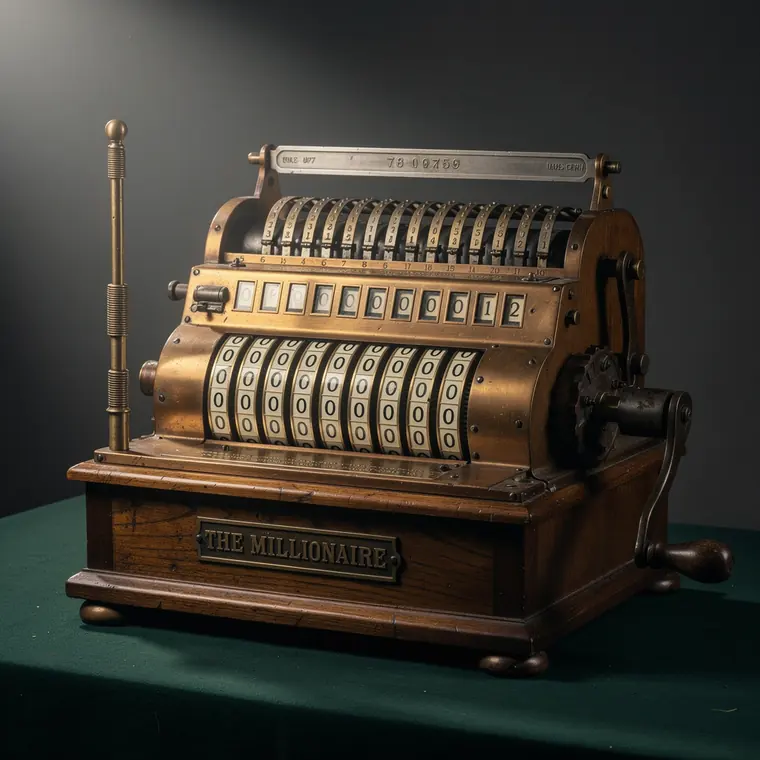
A broad direct-multiplication calculating machine in a polished oak case, a single tall lever on the left set to the multiplier digit, a row of setting slides across the top, a wide result carriage with two rows of numeral windows, each window showing the single digit 0, a cast plate on the front reading "The Millionaire", a crank with a heavy turned handle on the right, every other surface plain brass and polished oak, standing on a dark baize-covered table before a deep neutral background, a single raking light from the left raking across the row of setting slides.
- What it was used for
- According to John Wolff it was widely used where frequent multiplication and division were needed, especially in insurance, mining and the railways. Two universities can be documented — the Science Museum Group's example came from the School of Mathematics at City University, and the TU Dresden collection of historic calculating machines holds one from 1898 with a six-digit setting mechanism and a twelve-digit result register. According to Kevin Schindler of Lowell Observatory, Percival Lowell bought a Millionaire in 1914 for the calculations in his search for Planet X. It was no hand-held device: rechnerlexikon gives 36 to over 50 kilograms.
- What was new
- The machine represents the multiplication table mechanically and forms the partial products from it, the way a human computer uses a table learned by heart; stepped-drum and pinwheel machines build the product by repeated addition. TU Dresden sums up the gain: one crank turn per digit of the multiplicand is enough. According to Stephan Weiss it was the first direct multiplier built in series and sold in quantity. The number built is disputed: rechnerlexikon and the HNF give 4,655 for 1899 to 1935, while Herbert Bruderer, working from papers found in the Museum für Kommunikation in Bern in 2018, arrives at 5,099 for 1896 to 1941. The barb lies in the inverse operation: for division, where the advantage reverses, an auxiliary table was fitted inside the lid.
Further reading
- TU Dresden, Historische Rechenmaschinen: Millionär
- rechnerlexikon.de, Millionär
- Herbert Bruderer, Mystery Dating of the World-famous Millionaire Calculating Machine Solved (CACM Blog)
- Stephan Weiss, Multipliziermaschine Millionär (mechrech.info)
- John Wolff's Web Museum, Millionaire Calculating Machine S/N 2789
- Herbert Bruderer, Mystery Dating of the World-famous Millionaire Calculating Machine Solved (BLOG@CACM, 15.10.2018)
- Science Museum Group, Muldivo Millionaire calculating machine (1971-388)
- Kevin Schindler, Want to discover Planet X? You’ll need these three tools (Astronomy, 2015)