Mercedes-Euklid
1906 · Proportional Lever · Work 431 of 1,871
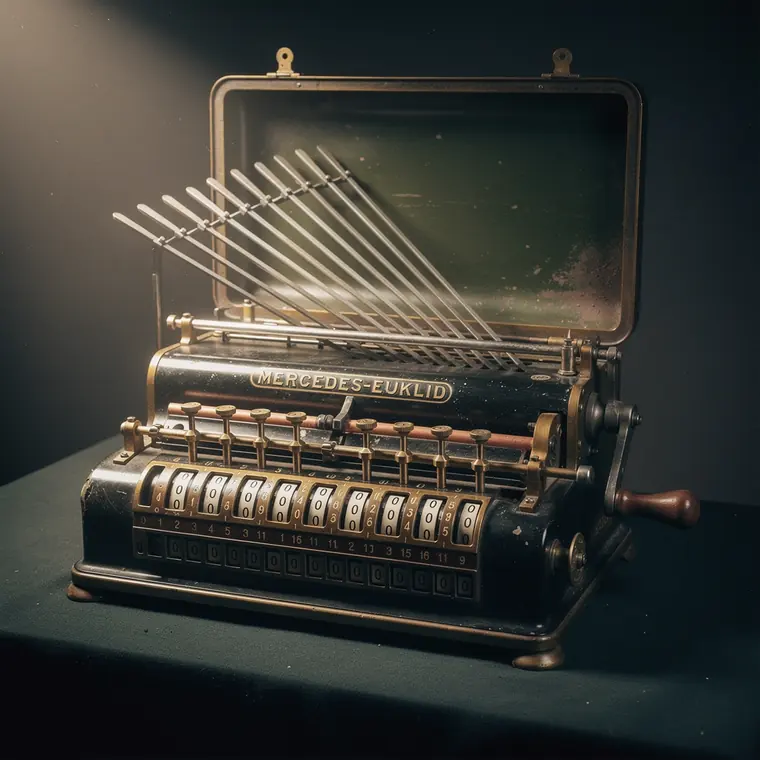
A calculating machine with the cover lifted to show a fan of straight steel levers pivoting from a common point, their free ends stepped across a rack, a row of nine setting knobs sliding in straight slots across the front, a scale of the digits 0 to 9 engraved beside each slot, a row of numeral windows below the slots, each window showing the single digit 0, a crank with a turned grip at the right, every other surface plain steel and black enamel, a maker's name across the top reading "Mercedes-euklid", standing on a dark baize-covered table before a deep neutral background, a single raking light from the left raking across the fan of levers.
- What it was used for
- One named user comes from a customer testimonial reproduced without its origin: the Guß- und Armaturwerk Kaiserslautern A.-G. reported the machine bought a year earlier as in daily use — a testimonial, not independent proof. Erhard Anthes writes that a machine is said to have been sold to a bank in 1908, and leaves the hedge in place. University use is well documented: the mathematical institute at Göttingen holds Model I, the electric Model 18, Model 29 and a model of the machine with drawings intended for ordering spare parts. The price in 1911, according to a 1938 Mercedes company text (on rechnerlexikon), was 950 to 1,050 Mark depending on capacity.
- What was new
- Instead of a stepped drum or pinwheel the Euklid works with a proportional lever: the digit is transferred as a length of travel across ten racks, not as a number of teeth on the driving member. Anthes writes that patent protection was apparently secured so thoroughly that this mechanism remained reserved to a single make over the long period of sixty years. Models 7 and 8 were, in his account, the first calculators beyond the experimental stage to carry out all four operations automatically once the numbers were entered. The descriptions ran ahead of the machine: the automatic division that Mehmke (1909) and Sust (1910) credited to Model 1 was a stop division, with levers to be shifted by hand, and only Model 9 of 1924 did away with that. The stepped-drum Madas, Anthes notes, could do it before the First World War.