Webb Adder
1868 · Disc Adder · Work 432 of 1,871
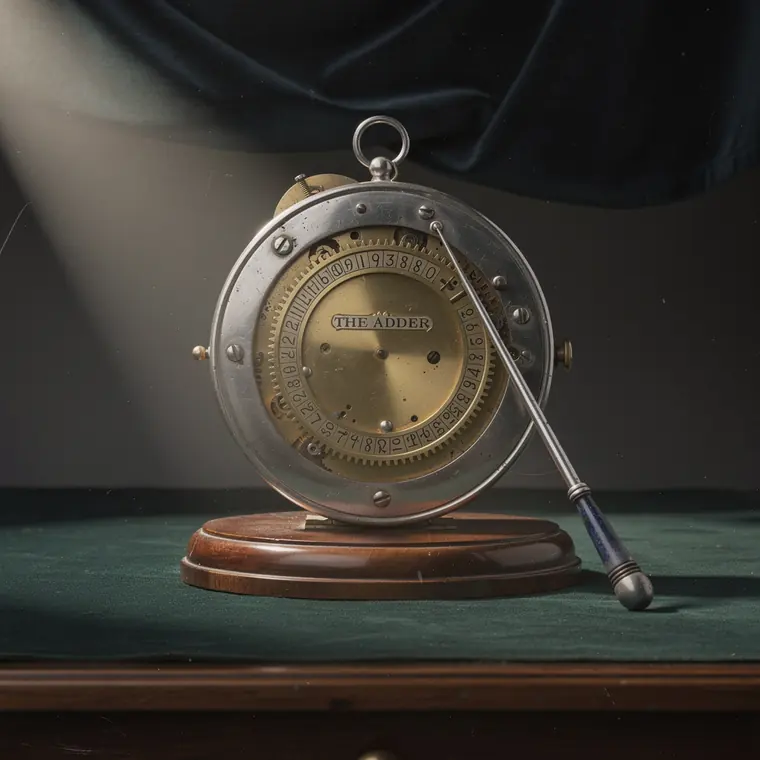
A flat circular adding device the size of a saucer, two concentric toothed rings of small numerals on a brass face set on a mahogany base, the larger ring bearing the digits 0 to 9 repeated around its rim, a short steel stylus lying beside it, a small ring for a watch chain at the edge, every other surface plain bright nickel, the face lettered "The Adder", standing on a dark baize-covered table before a deep neutral background, a single raking light from the left catching the teeth of the rings.
- What it was used for
- A small handheld adder with two dials worked by a stylus, sold by C. H. Webb in New York and later by Webb's Adder Co. The Early Office Museum gives the price as six to ten dollars in 1869 and seven dollars in 1890 to 1892. In 1869 it was advertised in Harper's Weekly, Scientific American and the American Agriculturist, among others; the 1869 advertisement promised to carry up the columns of a ledger account. Capacity was the limit: the right-hand wheel counts 00 to 99, the left-hand one 0 to 49, so totals reach 4,999.
- What was new
- Not a slide but a spring store for the tens carry: the force is wound up and released at the right moment, which is why moving the large wheel from 98 to 99 takes the same effort as moving it from 99 to 00. On simpler geared adders of its time the carry took extra force; according to Zeldes, Pascal had already solved this problem. What it could not do belongs in the account: only one carry transfer position, and 4,999 was the end. The improved carry of the second model is covered by patent US 414,335 of Lester C. Smith, assigned to Webb and granted on 5 November 1889; according to Scherphuis the redesigned model was sold from 1890. The first patent, US 75,322, is dated 10 March 1868; the wording of its claims was not consulted.