Troncet Arithmographe
1889 · Slide Adder · Work 433 of 1,871
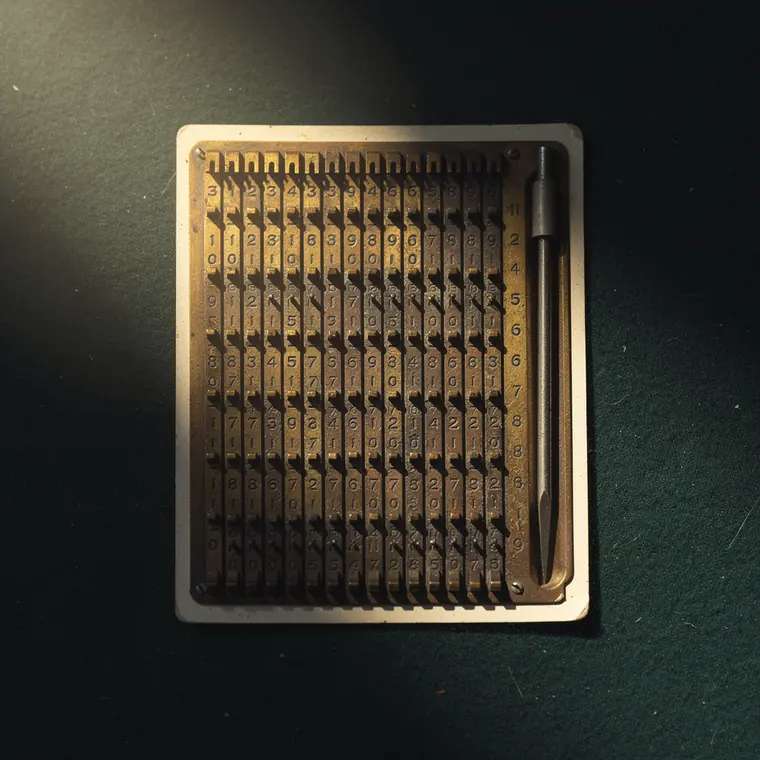
A slim adding slate the size of a postcard, parallel toothed slots running its length, a column of the digits 0 to 9 printed beside each slot, notched hooks at the top of each slot for the carry, a small metal stylus resting in a groove along one edge, the face of plain cream card with black rules, standing on a dark baize-covered table before a deep neutral background, a single raking light from the left raking across the toothed slots.
- What it was used for
- A flat pocket device worked with a stylus for running totals, distributed in France among others by Larousse. The example described by the MAA came in a small notebook with multiplication tables. According to Zeldes it handled seven-digit numbers with results into the millions. Sales in Russia began in 1892, that is in the home country of its model.
- What was new
- Technically little about it was new, and that is the point. Heinrich Kummer had presented the same slide adder to the St Petersburg Academy in 1846 and patented it in 1847; an American Kummer patent was issued on 19 May 1869, nearly twenty years before Troncet. The hook-shaped slot by which the stylus performs the carry is traced back to Kummer by the specialist source as well — cautiously, as the author's suspicion. What was new was the spread: the name Troncet became for a while the generic term for every device of this kind. The patent he did not keep up: filed in France on 30 April 1889, never published, because the second year's fees were not paid. Peggy Kidwell (MAA Convergence) and Zeldes nevertheless speak of a patent of 1889, and Apokin and Maistrov, as cited by Leipälä, of a patent obtained in 1891.