Herzstark's Drawing Table
1943 · Stepped Drum · Work 437 of 1,871
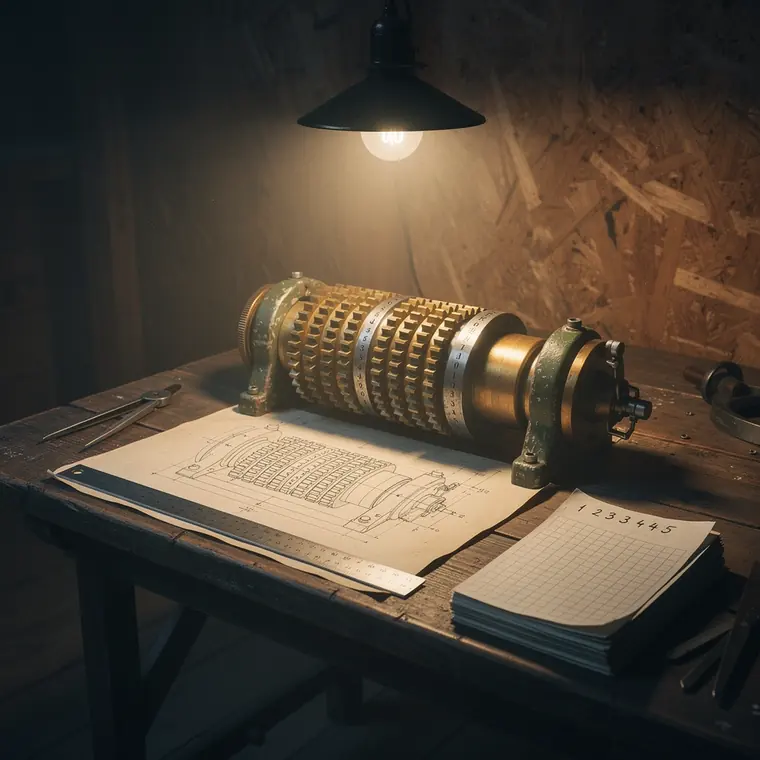
A small drawing table under a single bare electric bulb in an unpainted workshop, a technical drawing of a cylindrical calculating mechanism held flat by steel rules, the drawing sheet showing only line work of the drum and its stepped teeth, a pair of dividers and a stack of squared paper beside it, the rest of the room bare boards and shadow, the bulb the only light, its cone of warm light falling on the drawing and fading into grey darkness.
- What it was used for
- Curt Herzstark drew the design of his calculating machine as a prisoner in Buchenwald concentration camp. He was assigned to Gustloff-Werk II, thirteen production halls that the SS rented to the Wilhelm-Gustloff-NS-Industriestiftung in Weimar; in mid-1944, by the memorial's figures, over 3,000 inmates worked there day and night in eleven-hour shifts on rifles, artillery components and fine mechanics for rockets. Herzstark stood not at a machine but in production control, checking whether the machines were being used correctly and to full capacity. The drawings were made in what was called his own free time, on Sundays. A drawing table as a piece of furniture is not documented; the interview speaks of pencil drawings, complete with dimensions and tolerances.
- What was new
- What was new was not the drawing but the thing drawn: a stepped drum combining the teeth for addition and those for the nines complement in one body, where subtraction had previously required a second drum and the space for it. Herzstark had filed patent specification No. 747073 for a calculating machine with a single relay roller on 19 August 1938, five years before he was sent to Buchenwald. The barb stands in the transcript of the interview Erwin Tomash recorded with him in 1987: the department head held out the prospect that the finished machine, if it was well done, would be given to the Fuhrer as a present after the victory, and that he "will certainly make you an Aryan so that you can live in peace and as a German." Herzstark's own comment: "How honest that was, I am not sure." The drawings were finished as the war ended.
Further reading
- Oral history interview with Curt Herzstark, OH 140, Interviewer Erwin Tomash, 1987, Charles Babbage Institute (Transkript, UMN Digital Conservancy)
- Gedenkstätte Buchenwald, Armaments factory Gustloff-Werke II
- Curta - made in Liechtenstein, Ausstellungstafeln, Liechtensteinisches Landesmuseum Vaduz 2021 (Text Hansjörg Nipp)