The First of May
1851 · Great Exhibition · Work 440 of 1,871
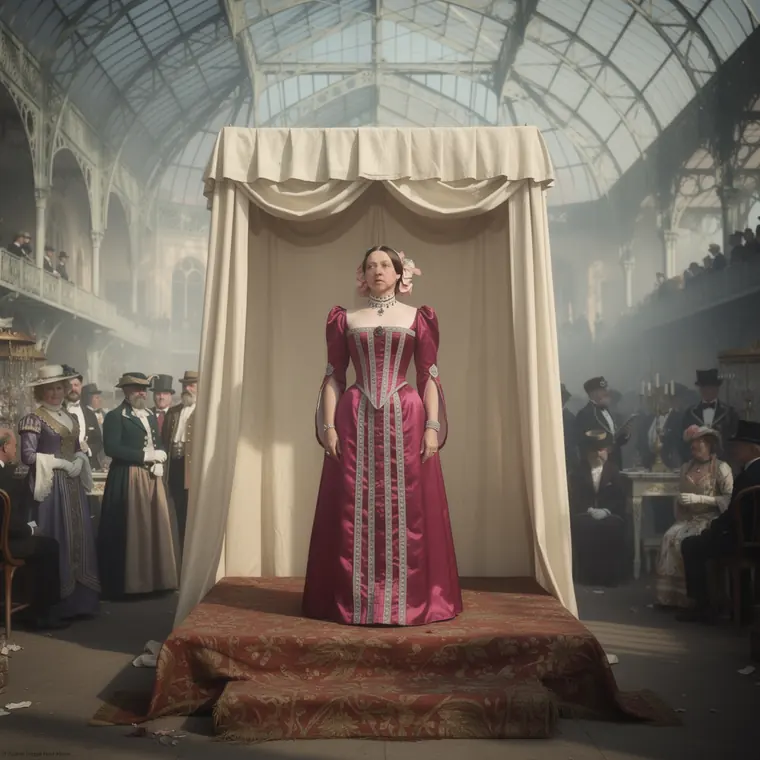
The transept crossing of the Crystal Palace, midday of 1 May 1851, sun after rain through the glass barrel vault, cast-iron columns painted pale blue, yellow and white, galleries on both sides crowded with men in dark coats and women in pale gowns, plain red panels on the gallery fronts, tall elms in leaf inside the building, a great fountain of cut glass behind the dais, a carpeted dais under a canopy of pale silk at the centre of the crossing, and standing full length at the front edge of the dais, at its exact centre and facing the camera, a living figure in the crowd and the only person whose face is sharp, the woman, a small woman of thirty-one in a dress of deep pink silk with vertical bands of silver, a diamond ray diadem on her brow and a small crown with two feathers at the back, her hand on the arm of a tall man in scarlet field marshal's dress with a pale blue sash in profile at her side, a girl in white and a boy in a Highland kilt beside them, an archbishop in white rochet at the edge of the dais, and before the dais rows of dignitaries seen from behind in scarlet and blue uniforms and black court coats.
- Who
- Queen Victoria (1819–1901) reigned over the United Kingdom from 1837 until her death, almost 64 years – at the time the longest reign in British history. She came to the throne at 18 and married Prince Albert in 1840. The couple had nine children, most of whom married into the royal houses of Europe. As a constitutional monarch Victoria had little power but considerable influence over her ministers. Her name stands for Britain's age of industry, prosperity and, above all, empire. Her reign also saw the famine in Ireland from 1845, the Second Opium War in China and the Indian rebellion of 1857. After it failed, the British government took over the direct rule of India, and in 1877 Victoria became Empress of India. After Albert's death in 1861 she sank into grief and wore black for the rest of her life. She died at Osborne House on 22 January 1901.
- The moment
- On 1 May 1851 the Queen opened the first world's fair, the "Great Exhibition of the Works of Industry of All Nations", in the glass Crystal Palace in London's Hyde Park. More than 25,000 people were inside. Towards half past eleven the royal procession left Buckingham Palace; a little rain fell as it set off, then the sun shone on the building, with the flags of all the nations flying from its roof. The picture shows the transept: Victoria, aged 31, in deep pink silk with bands of silver, stands on the dais beneath the canopy, beside her Albert, who had organised the exhibition, and their children Vicky and Bertie. Behind them rise the great glass fountain and the park's old elms, which had been enclosed under the glass. Albert read her the Commissioners' report and she replied briefly. Then came a prayer by the Archbishop of Canterbury, Handel's "Hallelujah" and a procession the whole length of the nave, before the exhibition was declared open in her name. In her journal she called it one of the greatest and most glorious days of "our lives".
- The other side
- No machine appears in Victoria's own accounts of the opening of the exhibition of the "Industry of All Nations". The day ran like a church service – prayer, Hallelujah, procession – and two days later Victoria wrote to her uncle Leopold that everyone had been filled with devotional feelings. On one of her further visits she spent two hours in the machinery section, noting that what used to be done by hand and took months was now accomplished in a few instants by the most beautiful machinery. And the man in Chinese dress who stands among the foreign commissioners in the painting of the opening was no envoy: there was no official Chinese delegation, and according to a key to the painting published in 1852 he "happened to be present".
What the sources leave open: The journal entry on the two hours among the machines is undated; one source places it on 1 May, which the timetable of the day hardly allows. Attendance figures vary between 20,000 and over 25,000. The arrangement follows Selous's painting of 1851–52; where the organ stood has not been verified. No sharp photograph of Victoria from around 1851 exists; the face follows a picture of 1857.
Further reading
Sources
- The Royal Family: Queen Victoria (r. 1837–1901) – Lebensdaten, Ehe, neun Kinder, konstitutionelle Monarchie, Empire, Kaiserin von Indien 1877, Tod 1901
- Royal Collection Trust (Prince Albert): Record of historical events – India (Aufstand 1857–59, direkte Herrschaft der britischen Regierung)
- PBS, Queen Victoria's Empire: Timeline (1845 Hungersnot in Irland, 1857 Aufstand in Indien und Zweiter Opiumkrieg)
- Royal Collection Trust (Prince Albert): The opening of the Great Exhibition 1851 (Podest in der Vierung, Bericht der Kommission, Tagebuchzitat)
- Royal Collection Trust (Prince Albert): The Exhibition (Tagebuch 1.5.1851, Eröffnung vor 20.000 Menschen, vier Abteilungen)
- Royal Collection Trust (Prince Albert): Queen Victoria's Dress for the opening of the Great Exhibition, RCIN 74851
- Victorian Web: Margaret Oliphant, Opening of the Great Exhibition (1902), mit Tagebuchauszug – Abfahrt halb zwölf, Regen, Fahnen, Vicky und Bertie, Bericht, Gebet, Hallelujah, Prozession, Breadalbane
- British History Online: Old and New London Bd. 5 (1878), S. 28–39 (Glasbrunnen, Baldachin, Breadalbane, Koh-i-Noor als Ausstellungsstück)
- Victoria and Albert Museum: The foundation of the V&A's Collections – the Great Exhibition of 1851 (erste Weltausstellung, 25.000 Jahreskarteninhaber, zehn Ulmen)
- V&A Collections O8820: Henry Courtney Selous, The Opening of the Great Exhibition (1851–52), Objekttext – über 25.000 Menschen, Hee Sing 'happened to be present', keine chinesische Delegation
- Project Gutenberg #24780: The Letters of Queen Victoria, Bd. II – an Leopold 3.5.1851 ('devotional feelings'), an Franz Joseph 5.5.1851 ('plusieurs visites')
- expo-museum.org: Queen Victoria's Journal – the Great Exhibition in 1851 (Maschinenpassage, Datierung dort nicht belastbar)