The Cipher Bureau, Warsaw
1932 · Biuro Szyfrów · Work 441 of 1,871
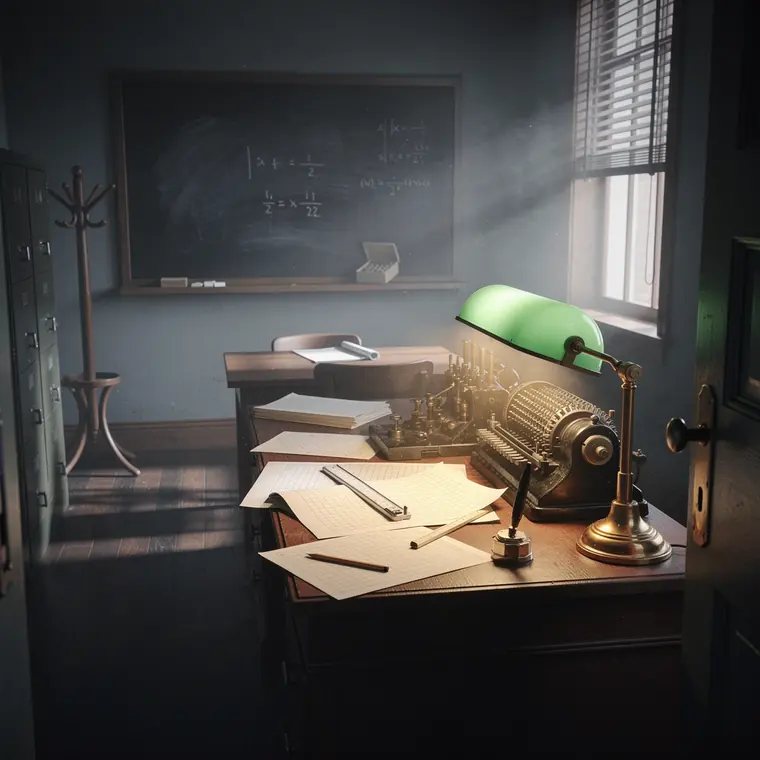
A quiet cipher bureau office of the early 1930s, three plain wooden desks pushed together into one long surface, ruled sheets with faint pencil grids spread across them in overlapping layers, a slide rule and a stub of pencil among the papers, a large blackboard on the back wall wiped to a soft grey haze of chalk dust with a few smeared streaks, a box of chalk on its ledge, a tall sash window at the side with the blinds half drawn, thin daylight slanting through the slats onto the paper, a green shaded desk lamp burning on the nearest desk as the strongest light, a brass inkwell catching it, dark varnished floorboards, filing cabinets and a coat stand fading into the shadow of the far corners.
- What it was used for
- The Biuro Szyfrów belonged to the Second Department of the Polish General Staff; its German section worked on German radio traffic. On 1 September 1932 Marian Rejewski, Jerzy Różycki and Henryk Zygalski started there as regular employees, after a military cryptology course in Poznań that they had attended with some twenty fellow students. The first weeks went on simpler naval ciphers; in early October 1932 Rejewski was given a separate room and a pile of Enigma research. The office turned into a workshop: by 1934 the office was already using a dozen or so replicas of the German machine from the Warsaw radio factory AVA.
- What was new
- The work relied not on linguistic methods but above all on the theory of permutations: Rejewski derived the internal wiring of the military machine theoretically, and later published the method himself as "An Application of the Theory of Permutations in Breaking the Enigma Cipher" (Applicationes Mathematicae 16, no. 4, Warsaw 1980). Rejewski dates the break to the turn of the years 1932-33, Władysław Kozaczuk more precisely to the first days of January 1933. The mathematics was not alone: in December 1932 the French Bureau of Ciphers supplied tables of German keys including the plugboard connections. The price came at the end: on 25 July 1939 in Warsaw the Poles handed their methods, equipment and machine replicas to the allies, and in September 1939 almost the whole equipment and the majority of the Bureau's files were destroyed before and during the evacuation.
Further reading
- Marian Rejewski, An Application of the Theory of Permutations in Breaking the Enigma Cipher, Applicationes Mathematicae 16(4), Warschau 1980 (PDF)
- Władysław Kozaczuk, The Origins of the Enigma, 1996 (PDF)
- Agencja Wywiadu (Polnischer Auslandsnachrichtendienst), Enigma decryption (PDF)
- Instytut Pamięci Narodowej, Ausstellungstafel ENIGMA B1 (PDF)