Enigma I with Plugboard
1932 · Steckerbrett · Work 447 of 1,871
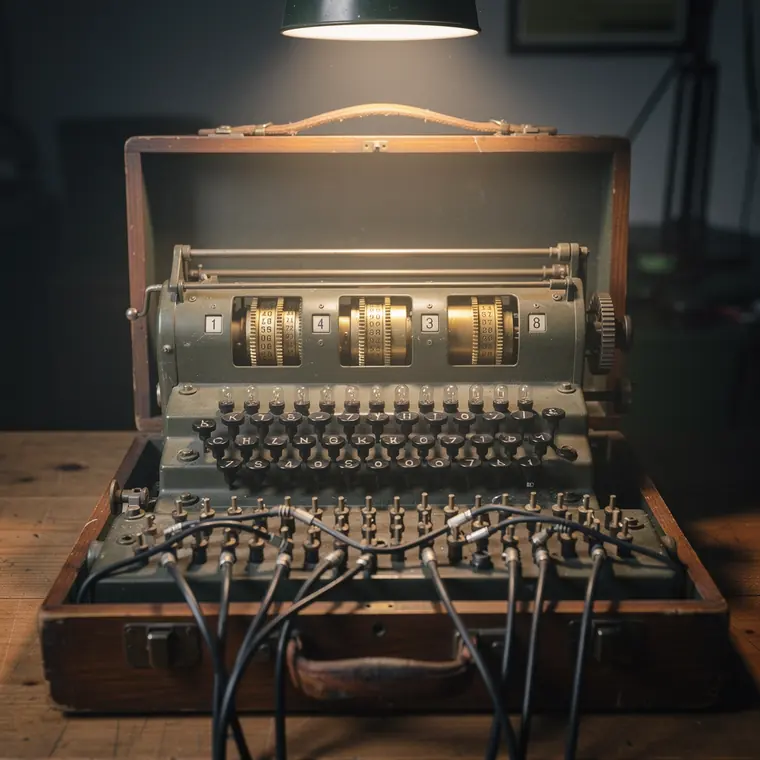
A military cipher machine open in its oak wooden case, three cipher rotors standing upright side by side on one horizontal spindle behind the lampboard, only the serrated brass thumb rims of the rotors showing through three slots in the rotor cover, each rim engraved with a ring of two-digit numbers, three small square windows in the cover each showing a two-digit number, the rotors hidden inside the machine below the cover, below the cover a lampboard of small round glass lamps set out in three staggered rows in exactly the pattern of the keyboard beneath, below the lampboard a keyboard of three staggered rows of round black keys, at the front of the case a plugboard of pairs of sockets crossed by a handful of short black cloth covered cables with double pin plugs, a leather carrying strap at the rear of the case, the whole standing on a plain wooden table, a single work lamp from above at an angle, the varnished wood and brass rotor rims catching the light, the room behind falling into darkness.
- What it was used for
- The service machine of the German armed forces and the most widespread Enigma of the Second World War: three chosen rotors, a fixed reflector - and at the front the plugboard, swapping pairs of letters before the current entered the rotor set and again after it left. Which pairs was laid down in the daily key. According to Hal Evans's Cambridge paper, the number of plugged pairs rose in October 1936 "from five to between six and eight". Bletchley Park puts the number of possible encryptions of this machine at 103,325,660,891,587,134,000,000.
- What was new
- What was new was not the rotor but what came before and after it: a substitution independent of the rotor assembly, changed with the key, which inflated the key space by orders of magnitude without altering the mechanism. According to Kenyon and Weierud the plugboard was "a secret invention which ChiMaAG had agreed to only use on machines delivered to the Reichswehr" - civilian machines went without it. Sources differ on when it was introduced: Bletchley Park writes "From 1927", Dirk Rijmenants gives 1932. The barb: the very separation of rotor set and plugboard opened the attack. Rejewski's cycle lengths, and later the British Bombe, worked with quantities the plugboard leaves untouched.
Connections
Every connection names its kind. “Forerunner” on its own would be a claim.
- Follows fromThe Enigma Commercial Machine1923Scherbius developed the Enigma for commercial use after the First World War, without a plugboard. The Navy adopted it in 1926, the Army two years later, the Air Force in 1935; it was the military that added the plugboard, as the National Museum of Computing puts it. By the NSA's account the military had changed the machine so much that a commercial model bought by the Poles was of no use to them.Source: The Enigma Machine - The National Museum of Computing, Bletchley Park · Jennifer Wilcox: Solving the Enigma - History of the Cryptanalytic Bombe. Center for Cryptologic History, National Security Agency
Further reading
- Enigmas of Bletchley Park (Bletchley Park Trust)
- David Kenyon, Frode Weierud: Enigma G - The Counter Enigma (Crypto Cellar)
- Hal Evans: Recreation of the Polish Cyclometer and its role in the breaking of Enigma (University of Cambridge)
- Dirk Rijmenants: Enigma Machine (Cipher Machines and Cryptology)