The Rotor Set
1938 · Walzensatz · Work 448 of 1,871
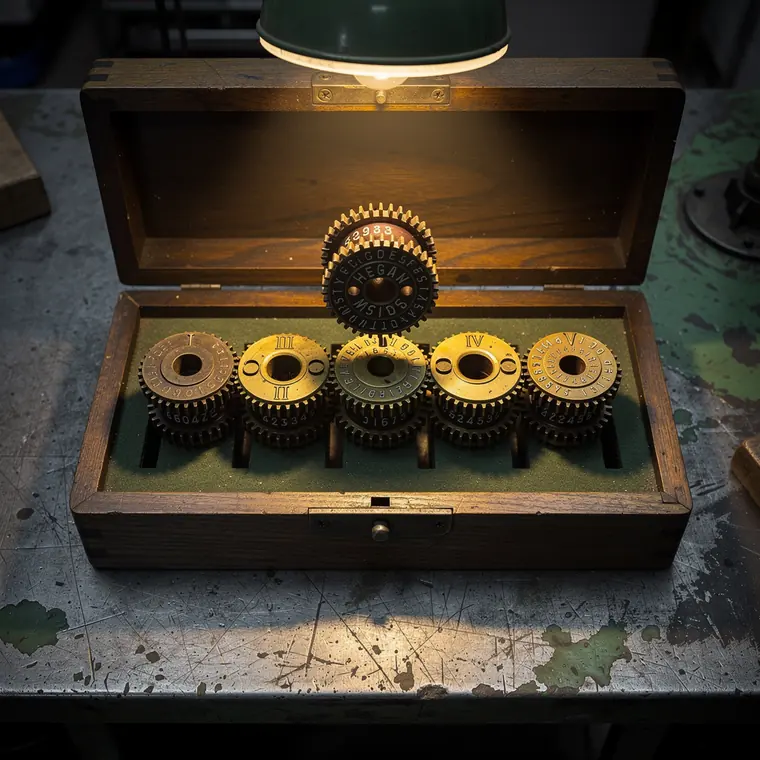
Five cipher rotors standing on end in a fitted wooden box with a hinged lid, a row of five discs side by side, each a bakelite disc in a brass ring with a toothed alphabet ring around it, the rings engraved with a circle of two-digit numbers, one face of each rotor carrying a ring of twenty-six small spring loaded pins, the other face a ring of flat contact plates, a Roman numeral stamped on the brass beside the centre hole of each rotor, felt lining inside the box, the box open on a workbench, a single work lamp from above at an angle, brass and bakelite gleaming against the dark grey bench, the rest of the room in shadow.
- What it was used for
- The rotor set was the exchangeable heart of the Enigma: a box of wired discs from which the operator chose three according to the daily key and inserted them in a prescribed order. Until the end of 1938 it was three out of three, giving six possible wheel orders. In December 1938 the Wehrmacht issued two further rotors, IV and V; from then on three were chosen from five, which is 60 wheel orders. The Kriegsmarine additionally held rotors VI, VII and VIII which, unlike I to V, carried two notches each according to Dirk Rijmenants.
- What was new
- What was new was not a technique but an arithmetic operation: the stock grew, the apparatus stayed the same. Two more rotors multiplied the attacker's work tenfold; the machines in the field were unchanged. The barb: this very cheapness struck the Polish side exactly where its lead was embodied in material. For 60 wheel orders they would have needed sixty bomby instead of six, and 1,560 Zygalski sheets - the figure is the Science Museum's. The Germans had not broken the Polish method; they had made it unaffordable.
Connections
Every connection names its kind. “Forerunner” on its own would be a claim.
- Works withEnigma I with Plugboard1932Three rotors from the set sit in the machine from left to right, each wiring twenty-six input contacts to twenty-six output contacts; current returning from the reflector passes through them a second time by a different route. Three rotors existed at first, later five, and eight in the Navy, from which three were chosen.Source: A. Ray Miller: The Cryptographic Mathematics of Enigma. Center for Cryptologic History, National Security Agency · Jennifer Wilcox: Solving the Enigma - History of the Cryptanalytic Bombe. Center for Cryptologic History, National Security Agency