Firth of Tay Bridge
1878 · Lattice Girder on Cast Iron Piers · Work 45 of 1,871
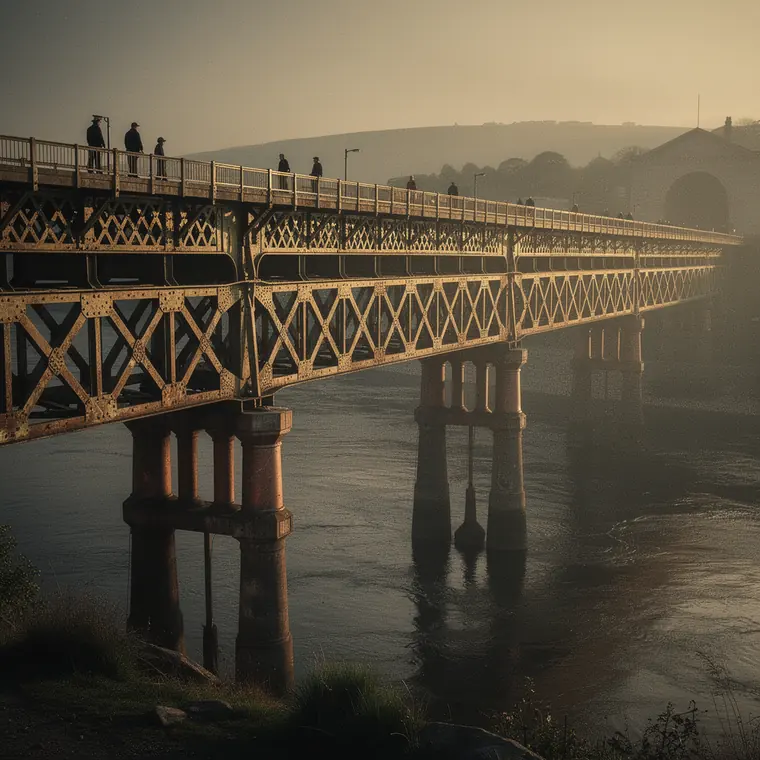
The first Tay Bridge running two miles from Wormit to Dundee, lattice girders resting on clustered cast iron columns, the taller high girders section standing over the navigation channel.
- What it was used for
- A single track railway bridge of the North British Railway across the Firth of Tay, opened to passengers on 1 June 1878. It linked Edinburgh via Dundee to Aberdeen, saving the ferry and the detour; it carried passenger and coal traffic, one train at a time under a baton token system. At 10,711 feet (3,265 m) it was the longest bridge in the world when completed. On 28 December 1879 the central section, the "high girders", collapsed in a gale with a train on it.
- What was new
- What was new was the scale, not the method: lattice girders on cast iron columns were standard practice, but here carried over 3.2 km. What the structure left to engineering history came out of its failure. The Court of Inquiry found that the cross bracing of the piers and its fastenings were too weak to resist heavy gales and that wind loading had never been adequately designed in; afterwards it became a required calculation. The death toll remains uncertain: 46 bodies were recovered, 56 tickets for Dundee had been collected, and estimates run from 59 known dead to about 75. Thomas Bouch had been knighted on 26 June 1879, six days after Queen Victoria crossed the bridge, and died less than twelve months after the collapse.