Abwehr Enigma G
1938 · Enigma G, Multi-Notch Rotors · Work 452 of 1,871
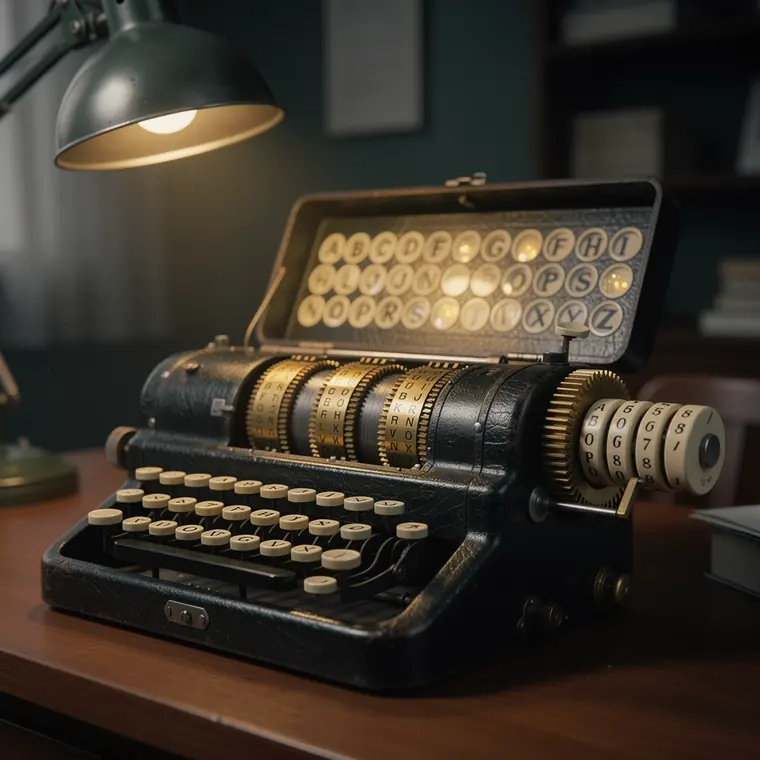
A compact cipher machine in a black wrinkle painted metal case with a hinged lid, a row of three small cipher rotors side by side, each rotor rim toothed like a cogwheel with many teeth all the way around, the rotor rims engraved with a ring of capital letters, a lampboard of small round windows each bearing a single capital letter, a keyboard below with each key cap bearing a single capital letter, a mechanical counter with four digit wheels mounted at the right side of the case, the front of the case a smooth painted panel, the machine standing on a plain wooden desk, a single work lamp from above at an angle, black paint and brass rotor rims catching the light, the office behind in darkness.
- What it was used for
- A counter Enigma, also called the G31; its biggest user, though neither the first nor the only one, was the German military intelligence service, the Abwehr, which used it for its internal radio network. It had no plugboard but used "pinion and gear wheels instead of the ratchet and pawl arrangement" - the rotors could be turned forwards and backwards, so keying errors could be corrected - and a 4-digit counter that tallied the enciphered characters. According to Kenyon and Weierud the rotors carried 17, 15 and 11 notches, numbers relatively prime to one another. By today's estimate "less than 350 machines were produced"; the highest documented serial is G 426.
- What was new
- Its hallmark was the irregular stepping, cryptographically unchanged from its predecessor, the A28: many notches, relatively prime to each other, kept the rotors from advancing in the plain odometer rhythm of the Wehrmacht Enigma, which lengthened the period. The counter was an operating aid, not a cryptographic one. The barb lies in what was missing: according to Kenyon and Weierud the plugboard was contractually reserved by ChiMaAG for machines delivered to the Reichswehr. The more ingenious mechanism did not save it. Dilly Knox made his first break at the end of October 1941, the first complete message was deciphered on 8 December 1941, and breaking the Abwehr ciphers, "both machine and hand", "played an important part in the double-cross system of rounding up and turning the Abwehr's agents in Britain".