The Wrens' Billet
1943 · Bombe Operation · Work 455 of 1,871
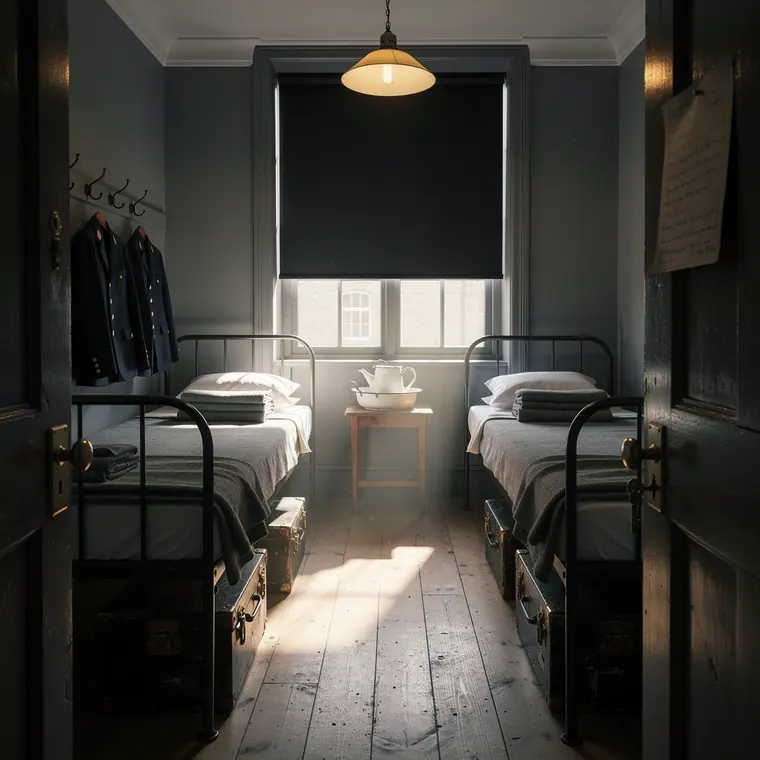
A requisitioned country house room converted to a dormitory, iron bedsteads in two rows with grey blankets folded square at the foot of each, navy uniform jackets hanging on hooks along the wall, a plain card pinned by the door, tall windows covered with black blackout blinds, a bare bulb in a paper shade hanging from the ceiling as the only light, a small tin trunk beneath each bed, bare floorboards, a washstand with jug and basin in the corner, the far end of the room fading into darkness.
- What it was used for
- The quarters and duty of the members of the Women's Royal Naval Service who operated the Bombes. Most machines stood not at Bletchley Park but at outstations: Wavendon, Adstock, Gayhurst, Stanmore and, from September 1943, Eastcote. Work ran in "three eight-hour watches per day". According to the "Bletchley Park Jewels" pages the machine blocks "had only tiny windows at ceiling level", so that little daylight and the heat of the machines made conditions poor; for Wavendon and Gayhurst "cold living quarters and lack of transport" are recorded.
- What was new
- What was new was the form of work, not the device: a computing installation running around the clock in shifts, spread over outstations and operated by women trained on the job. The National Museum of Computing states that by the end of the war "almost 1676 female WRNS and 263 male RAF personnel" were involved with around 211 Bombes - roughly eight operators per machine. The barb: the fast machine generated handwork. Joan Murray, who worked at Bletchley Park herself, writes that "even with experienced WRNS operators, much time during runs was spent in checking those wheels which had just been dismounted, and stroking any displaced wires back into position".