M-209 Converter
1940 · Hagelin Pin-and-Lug · Work 458 of 1,871
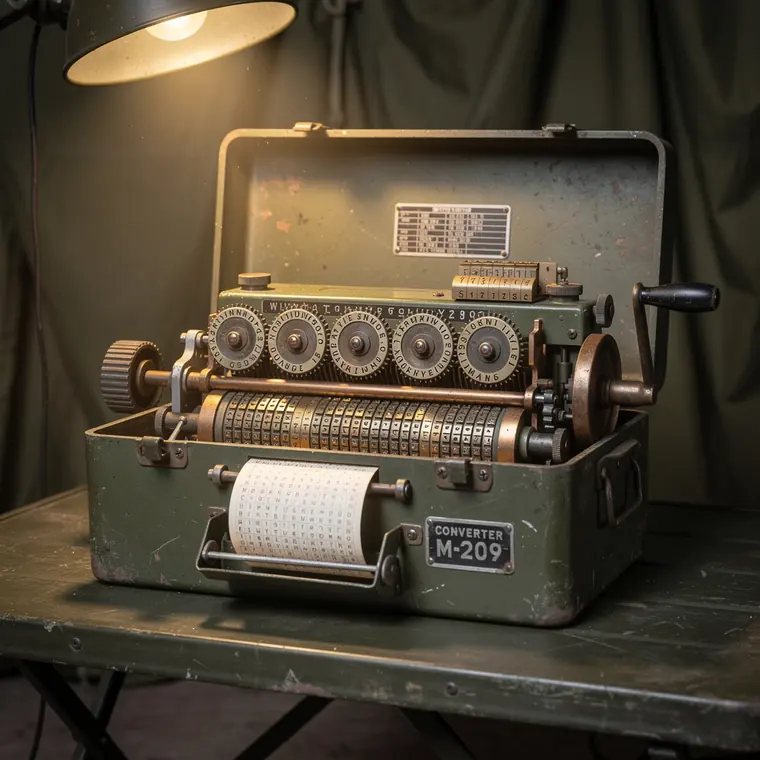
A compact field cipher machine in an olive drab green wrinkle painted metal box, six pin wheels in a row along the top with movable pins around their rims, each wheel rim engraved with a ring of capital letters, a drum of sliding lugs behind the wheels, a folding hand crank at the right side, a small printing wheel with a narrow paper strip at the left, a letter counter on top, a data plate on the lid reading "Converter M-209", the lid hinged open, the machine on a folding field table, a single lamp from above at an angle, green paint and bare steel catching the light, canvas and darkness behind.
- What it was used for
- Tactical field cipher device of the US forces, CSP-1500 in the Navy. It derived from Boris Hagelin's C-38 and worked by pin and lug: six key wheels with 26, 25, 23, 21, 19 and 17 positions — so Mark Blair (NF6X) in 2009, citing the manual TM 11-380 of 17 March 1944 — whose cycles are mutually prime, giving a period of 101,405,850. It measures 178 × 140 × 83 mm, weighs 2.7 kg, needs no power and prints the cipher text onto a paper strip. About 140,000 were built under licence by L.C. Smith & Corona at Syracuse. Hagelin sold the rights to the US government for 8,614,790 dollars; the Crypto Museum states that 1.8 million remained to him net, while Smith & Corona made a profit of 5 million.
- What was new
- What was new was not pin-and-lug; Hagelin had used it since the 1930s. The device needed no power and printed the text as it went. What that was worth in practice is in the post-war assessments: the Crypto Museum reports the assumption, as of early 1943, that German codebreakers could break an M-209 message in under four hours, but notes that in fact it typically took them several days or even weeks and required messages in depth. In all, the Germans read 10 per cent of American Hagelin traffic — 6 per cent by cryptanalysis, 4 per cent from captured keys — with a delay of 7 to 10 days between intercept and decrypt.