Purple
1939 · Type 97 Stepping Switches · Work 459 of 1,871
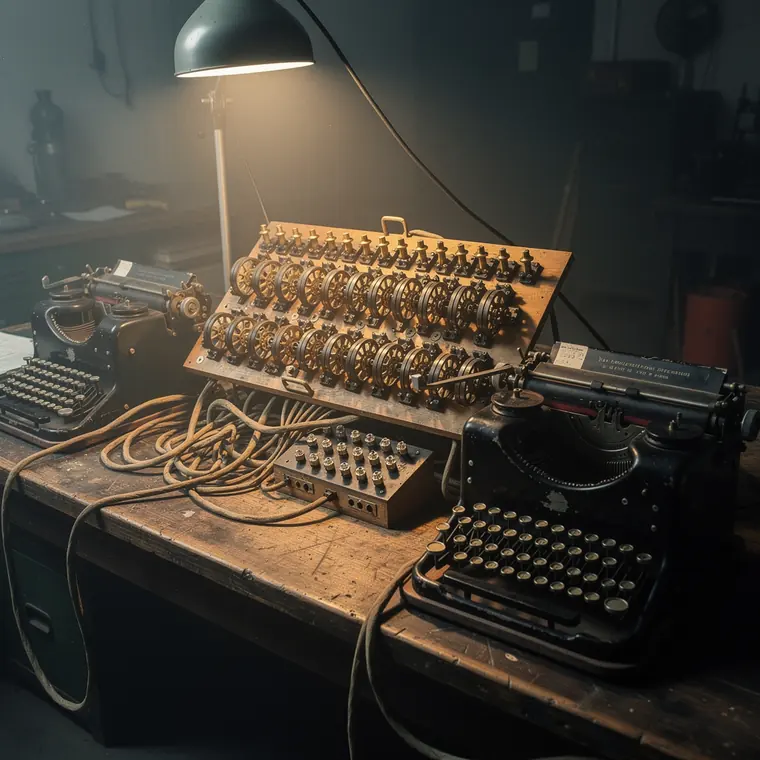
A cipher apparatus built from telephone exchange stepping switches, banks of rotary contact switches mounted on a plywood board, each switch a half circle of contact points with a sweeping wiper arm, a thick tangle of cloth covered wire beneath them, a plugboard with sockets at one side, two office typewriters connected at either end of the board by heavy cables, the whole on a long wooden table, a single work lamp from above at an angle, bakelite and brass contacts catching the light, the room behind in darkness.
- What it was used for
- From 1939 the Japanese foreign ministry enciphered the traffic between Tokyo and its embassies with it. The Japanese called it 97-shiki ōbun inji-ki, also Angooki Taipu B; the Americans called it Purple. It was not a rotor machine: switching was done by telephone stepping switches of 25 positions. The Signal Intelligence Service built an analogue without ever having seen the original — the NSA museum states that no westerner had ever seen a Purple machine. Leo Rosen, an MIT-educated Army officer, took uniselectors from telephone exchange practice and connected the sections with 500 wires. After some 18 months in the dark the break came in September 1940. Freeman, Sullivan and Weierud record that, as far as is known, only a few parts of one real machine were ever recovered, at the end of the war.
- What was new
- The novelty was the material: a cipher device built from telephone stepping switches instead of rotors. Whether Purple was the first such device is not documented. What it did carry over from its predecessor Red was the split into sixes and twenties. Freeman, Sullivan and Weierud describe it thus: a sixes letter was only replaced by itself or another sixes letter, a twenties letter only by a twenties letter — the two halves never mixed. That separation is precisely what gave SIS its handhold. The Japanese kept the machine in use to the end of the war.