Siemens T52 Geheimschreiber
1932 · T52 Cipher Attachment · Work 461 of 1,871
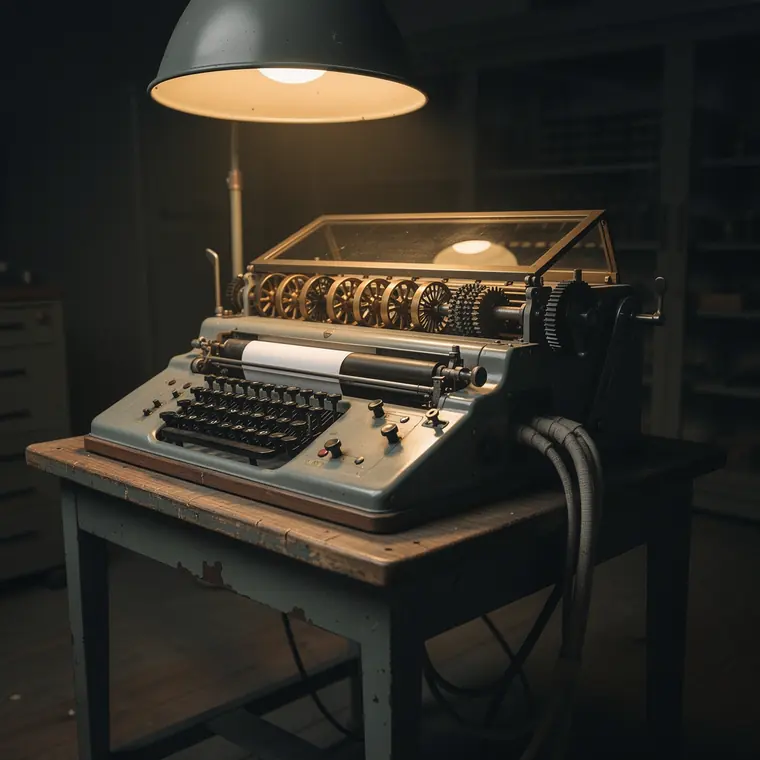
A large cipher teleprinter on its own heavy steel table, ten pin wheels in a row behind a hinged cover on the upper deck, each wheel with a different number of segments, a teleprinter keyboard and paper strip printer below with each key cap bearing a single capital letter, thick cables running from the back of the machine down into a duct in the floor, a die cast chassis on a wooden base plate, the whole in grey enamel, a single work lamp from above at an angle, brass wheel rims and black keys catching the light, the teleprinter room behind in darkness.
- What it was used for
- A teleprinter with a built-in cipher attachment, for teleprinter traffic over land lines. Ten wheels with 73, 71, 69, 67, 65, 64, 61, 59, 53 and 47 positions; five of them add bits to the plain text, the other five drive a relay transposition of the five impulses. According to the account on cryptocellar the wheels' notches were fixed and could not be changed. The device carried military and diplomatic correspondence; the same source dates the introduction of the T52c to 21 July 1942 and the T52ca to 23 February 1943. From 14 April 1940 Germany routed its traffic between Berlin and occupied Oslo over the Swedish west coast cable — through a neutral country.
- What was new
- Adding a key stream was not new; a machine built by the US Signal Corps with AT&T in the First World War already did it, and the Lorenz SZ did nothing else. What set the T52 apart was the combination of two methods in one device: addition plus a mechanically driven transposition of the five impulses. What that was worth became clear in 1940. The NSA account records that a Swedish interception group was set up on 21 May 1940 and that Arne Beurling, professor of mathematics at Uppsala, could present a mathematical model of the machine by the middle of June — with no machine and no captured material, working from the fact that operators repeatedly used the same key. Swedish engineers then built more than thirty decrypting machines. By the time the traffic became unreadable in early 1944, 300,000 messages had been solved.
Connections
Every connection names its kind. “Forerunner” on its own would be a claim.
- Parallel toLorenz SZ401940Two German cipher machines for high-level teleprinter links, from two makers: Siemens & Halske built the T52, Lorenz the SZ40 cipher attachment. The T52 was adopted by the Air Force and Navy, the SZ40/42 were an Army development. The T52 wheels were moulded in Bakelite with a fixed pattern; the Lorenz wheels carried movable metal cams.Source: Cryptologic Almanac: The Breaking of Geheimschreiber (NSA, declassified) · Frode Weierud, Bletchley Park's Sturgeon, the Fish that Laid No Eggs, The Rutherford Journal