Lorenz SZ42
1942 · Lorenz Attachment · Work 463 of 1,871
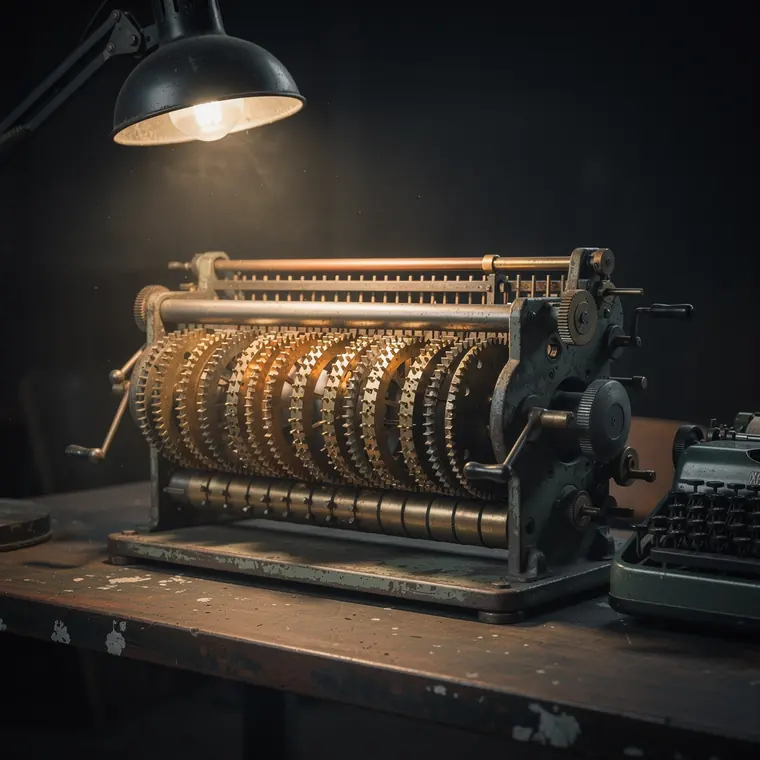
The later cipher attachment with its cover removed, twelve toothed wheels in a row on a common shaft, each wheel with movable cams around its rim, the cam settings visible as a pattern of raised and lowered tabs around each wheel, wheels of different diameters, a steel frame around them, the attachment standing on a steel table with a teleprinter beside it, a single work lamp from above at an angle, brass cams and steel catching the light, the room behind in darkness.
- What it was used for
- The development of the SZ40 on the same links. Copeland dates the introduction of the SZ42A to February 1943 and that of the SZ42B to June 1944; for the plain SZ42 — the year in the title — the checked sources give no introduction date. The links carried fish names at Bletchley: Jellyfish for Berlin–Paris, Bream for Berlin–Rome, Turbot for Berlin–Copenhagen. The National Museum of Computing describes the British Tunny machine as a re-engineering of precisely this SZ42, which nobody in Britain had yet seen.
- What was new
- What is new against the SZ40 is the limitation on the psi movement. The description in GCHQ's CyberChef wiki, written by @VirtualColossus, sets it out: in the SZ40 the motor wheel M37 alone decides; in the SZ42A the position of the second chi wheel one step back is added, and in the SZ42B that of the first psi wheel one step back as well. To this came the switchable plain-text function (Klartextfunktion, KT-Schalter), which brings in the fifth impulse of the plain text from two characters back — the key then depends on the text it hides. That strengthens the cipher and punishes every transmission error; the same description notes that the function sometimes caused reception problems. What the limitation gained in service the checked sources do not say.
Connections
Every connection names its kind. “Forerunner” on its own would be a claim.
- Follows fromLorenz SZ401940The SZ42 is the later model of the same Lorenz series: the SZ42A came in February 1943, the SZ42B in June 1944. For 1944, when the SZ42B was in use, Tiltman shows the patterns of the same twelve wheels and notes a security attachment the SZ40 did not have. The SZ40 stayed in use on cable links.Source: John Tiltman, The 'Tunny' Machine and Its Solution (1961) · B. Jack Copeland, Colossus: Breaking the German 'Tunny' Code at Bletchley Park, The Rutherford Journal · Frode Weierud's CryptoCellar: The Lorenz SZ40/42 Cipher Machine (Dokumentenverzeichnis)