Heath Robinson
1943 · Optical Tape Comparator · Work 466 of 1,871
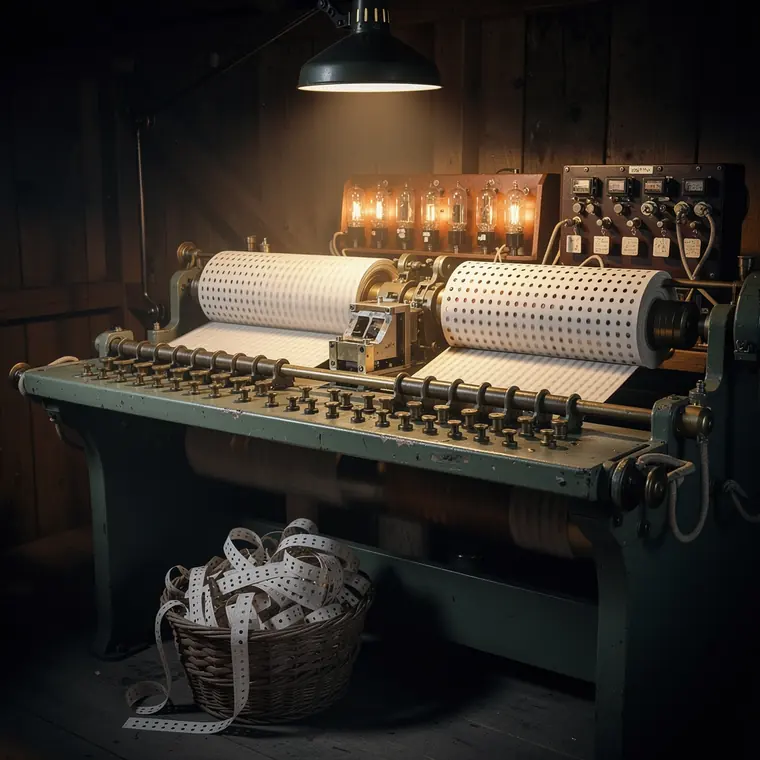
A counting machine with two long loops of punched paper tape running over a bedstead frame of pulleys at speed, the tapes punched with rows of small round holes, a photocell reader between them, a rack of glass valves and electronic counters behind, the tape loops stretched taut across the frame, spare tape spilling into a wicker basket on the floor, the machine in a hut workroom, a single work lamp from above at an angle, the glowing valves and moving tape catching the light, the room behind in darkness.
- What it was used for
- A machine for the Newmanry, meant to find the start positions of the chi wheels by Tutte's statistical method. Two paper tapes, cipher text and wheel pattern, ran side by side through an optical reader at over 1,000 characters per second; the coincidences were counted. The counter rack came from the Telecommunications Research Establishment at Malvern, the tape transport — the Bedstead — and the valve rack from the Post Office research station at Dollis Hill, to circuit designs by C. E. Wynn-Williams; the Bedstead was designed by Arnold Lynch and Eric Speight. Tony Sale dates its delivery to Bletchley Park to June 1943, and The National Museum of Computing dates it becoming operational there to the same month.
- What was new
- The machine did statistics on a cipher: for each wheel position it counted the coincidences between two streams, more than a thousand times a second. The idea was not entirely new; from 1935 Vannevar Bush had designed the Comparator for the US Navy, meant to count coincidences between two messages. The price was the second tape. Tony Sale describes it as a major problem to keep the two tapes in synchronism at over 1,000 characters per second: sprocket drive tore the tapes, so a friction drive was adopted, and the tape still stretched between sprocket and reader aperture. The National Museum of Computing names the further defects — constant tape changes, heavy maintenance, no scalability — and writes that Tommy Flowers went on to develop Colossus in consequence.
Connections
Every connection names its kind. “Forerunner” on its own would be a claim.
- Works withNewmanry Tape Loops1944Heath Robinson, the Newmanry's first machine, ran from June 1943 on two loops of teleprinter tape in a frame nicknamed the bedstead: a message tape and a chi tape, up to 2000 characters per second, read by photo-electric cells.Source: B. Jack Copeland, Colossus: Breaking the German 'Tunny' Code at Bletchley Park, The Rutherford Journal · IEEE Milestone Proposal: The Colossus Computers, 1944-1945