Newmanry Tape Loops
1944 · Paper Tape Preparation · Work 475 of 1,871
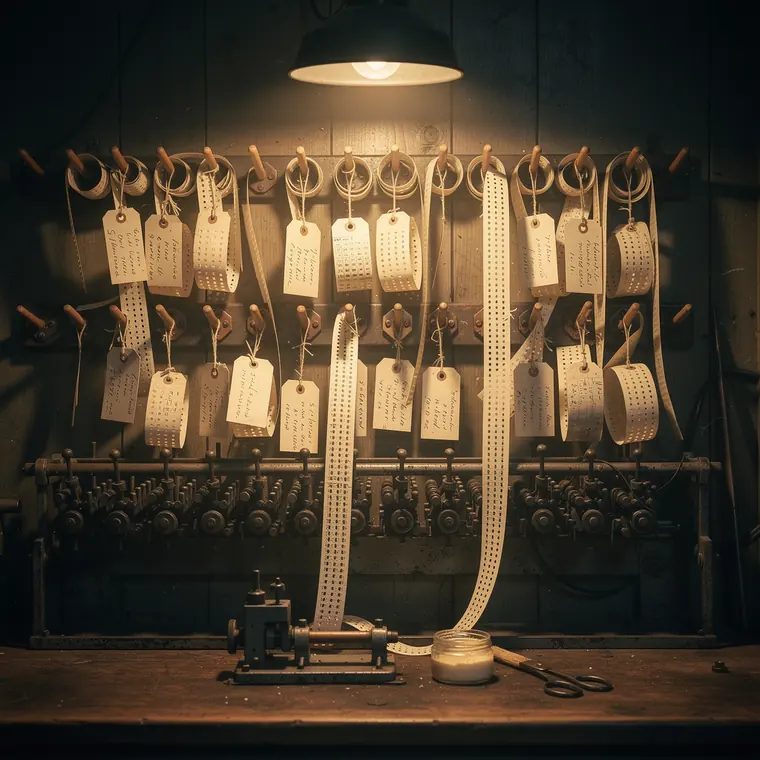
A workroom wall hung with dozens of loops of punched paper tape on wooden pegs, each loop with a small plain tag of card tied to it, tape ends curling, the tapes punched with rows of small round holes, a splicing jig and a pot of glue on the bench below, a brush and a pair of scissors, a single work lamp from above at an angle, the pale tape loops bright against the dark wooden wall, the rest of the room in darkness.
- What it was used for
- The working material of the Newmanry, Max Newman's section for mechanised methods. The intercepted Tunny message was punched in Baudot code and stuck into a closed circuit; the General Report on Tunny describes stop and start signs punched with a special metal gadget and an overlap of two sprocket holes at the join. For the Robinson machines a mixture of Bostick and benzene was applied with heated plates. If the text was below 1,500 characters, copied tapes were made with RYRY appended until the length exceeded 1,500. On Heath Robinson the loop ran over the bedstead, an angle-iron frame, on wooden wheels about ten inches in diameter.
- What was new
- Nothing was invented here, and that belongs in the field: punched tape and loops were off-the-shelf teleprinter practice, and the General Report on Tunny documents the practice, not its priority. What was new was the rule rather than the device: the loop's length became the unit of counting, and a minimum length of 1,500 characters was set, short messages being padded with RYRY. The price lay in the join. Copeland reports of Heath Robinson that tapes would sometimes tear or come unglued, fly off the bedstead at high speed and break into fragments that festooned the Newmanry.
Connections
Every connection names its kind. “Forerunner” on its own would be a claim.
- Works withColossus Mark 11943The Newmanry, Max Newman's section, set out to build machines for breaking Tunny; this led to the Colossus computers. Colossus read teleprinter characters at 5,000 characters per second from a paper tape joined into a loop; special holes punched just before the start and just after the end of the text controlled each pass.Source: Tony Sale (Codes and Ciphers Heritage Trust): The Colossus · The National Museum of Computing: Tunny and Heath Robinson