Colossus Mark 1
1943 · Valve Computer · Work 473 of 1,871
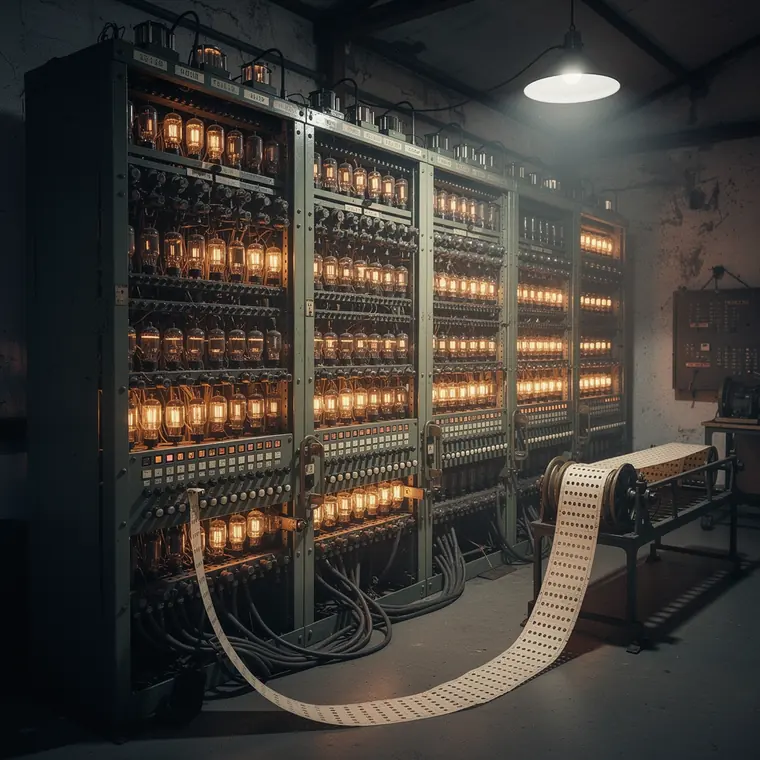
A room sized machine of tall steel racks filled with some fifteen hundred glass valves glowing softly, a punched paper tape running in a long loop over a bedstead frame of pulleys at the side, the tape punched with rows of small round holes, plugboards and rows of switches on the front panels, status lamps along the top, thick cables bundled between the racks, the machine in a bare hut room, a single work lamp from above at an angle, warm valve glow against grey steel, the racks receding into darkness.
- What it was used for
- Built against the German teleprinter cipher Lorenz SZ40/42, called Tunny at Bletchley Park, not against Enigma. Tony Sale, who led the rebuild, states the principle: the machine counted, throughout the length of the text, how often a Boolean function between the tape text and electronically generated wheel patterns came out true or false, and so found the chi wheels' start positions. Built by Tommy Flowers at the Post Office research station at Dollis Hill with Chandler, Broadhurst and Coombs. The prototype ran at Dollis Hill in December 1943 and reached Bletchley in January 1944; the General Report on Tunny dates its arrival to February 1944. It read 5,000 characters per second from paper tape.
- What was new
- Not "the first computer": no stored program, built for one task. What was new is what Flowers left out. Its predecessor Heath Robinson had to keep two paper tapes in synchrony at 1,000 characters per second, which per Tony Sale did not work reliably; Flowers generated the wheel patterns electronically in ring circuits, thereby doing away with one tape and eliminating the synchronisation problem entirely. Only that allowed 5,000 characters per second. Sources differ on the valve count: Tony Sale says 1,500, Copeland about 1,600. The machine stayed secret for some 30 years; only in October 1975 did the British government acknowledge its existence.
Connections
Every connection names its kind. “Forerunner” on its own would be a claim.
- Follows fromHeath Robinson1943Tommy Flowers was asked whether he could improve on the Heath Robinson. Rather than modify it he proposed Colossus, to overcome its limits: valves generated the wheel patterns electronically and did away with the second paper tape, which on the Robinson was extremely hard to keep in synchronisation.Source: The National Museum of Computing: Tunny and Heath Robinson · Tony Sale (Codes and Ciphers Heritage Trust): The Colossus
- Follows fromLorenz SZ401940In January 1942 Tutte deduced the structure of the Lorenz machine, whose first model was designated SZ40: twelve wheels in three groups, five chi, five psi and two motor wheels. Flowers built on this: in February 1943 he proposed a fully electronic machine generating the chi, psi and motor streams internally. Colossus generated the chi-stream electronically inside the machine.Source: B. Jack Copeland: Colossus - Breaking the German 'Tunny' Code, The Rutherford Journal · IEEE Milestone: The Colossus Computers, 1944-1945 (Engineering and Technology History Wiki)