The Turing–Welchman Bombe
1940 · Bombe · Work 470 of 1,871
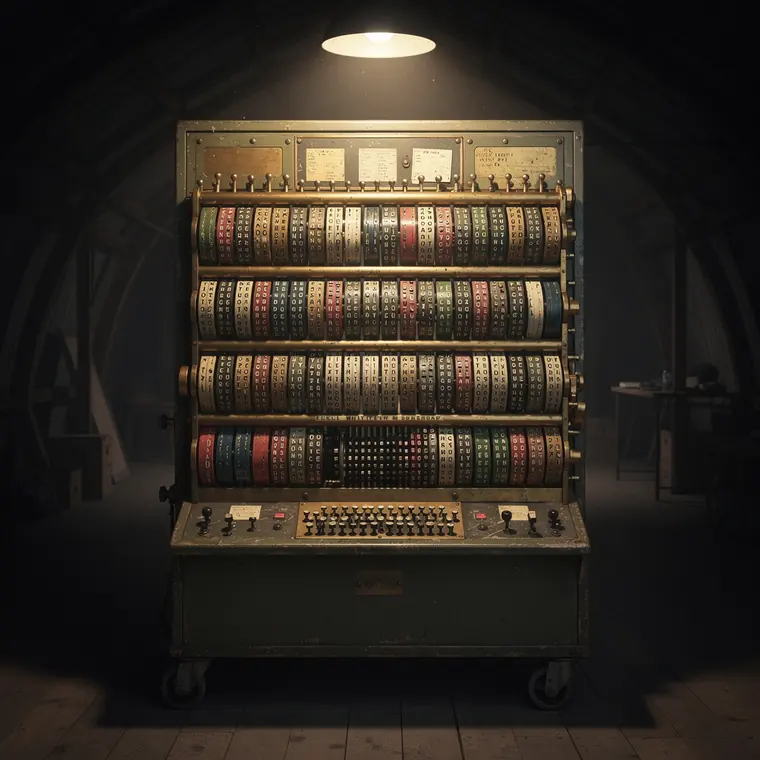
A bronze coloured metal cabinet the height of a wardrobe and wider than it is tall, its front face covered in rotating drums arranged in three horizontal rows of thirty-six, grouped in banks of twelve, each drum a coloured cylinder with a ring of capital letters around its rim, a grid of drums filling the whole front, the cabinet standing on castors in a long hut room, a single work lamp from above at an angle, the coloured drums and brass fittings catching the light, the room behind in darkness.
- What it was used for
- The electromechanical machine that tested Enigma rotor settings against a crib. Frank Carter defines a crib as a sequence of plain-text letters that can be matched one to one with cipher-text letters, and names stereotyped messages, such as wireless tuning transmissions, as their source. Carter describes the layout: 36 sets of three drums arranged vertically in three banks of twelve, each set corresponding to the three rotors of an Enigma. A run took approximately 18 minutes. The machine was built at the British Tabulating Machine Company under H. H. "Doc" Keen; Tony Sale writes that the first one, called Victory, was completed by March 1940 and delivered to Bletchley Park. By the end of the war, Carter states, over two hundred were in operation.
- What was new
- The bombe was not the first machine against Enigma: according to the Crypto Museum it was partly based on the Polish bomba of 1938, which exploited the message key being sent twice. What can be documented is what the British machine could do: it did not work from a weakness in the keying procedure but from guessed plain text, and with Welchman's diagonal board it gained an addition that GCHQ calls a dramatic improvement to Turing's Bombe. Carter spells out the effect: simpler menus and considerably fewer false stops. The ending is also from Carter — after the war most of the machines were destroyed, a small number retained for a few years and then scrapped too, so that in the end none survived.
Connections
Every connection names its kind. “Forerunner” on its own would be a claim.
- Follows fromThe Bomba Kryptologiczna1938In July 1939 the Polish codebreakers passed their work to the British and French; the visitors saw Enigma replicas and the Polish machine, and Turing and Welchman were then briefed on the Polish work. NSA's Center for Cryptologic History calls the British bombe a completely redesigned Polish machine; it now searched by cribs instead of message indicators.Source: Center for Cryptologic History (NSA): Solving the Enigma - History of the Cryptanalytic Bombe · Turing Welchman Bombe Rebuild Project: Enter Turing and Welchman