The Bomba Kryptologiczna
1938 · Bomba · Work 444 of 1,871
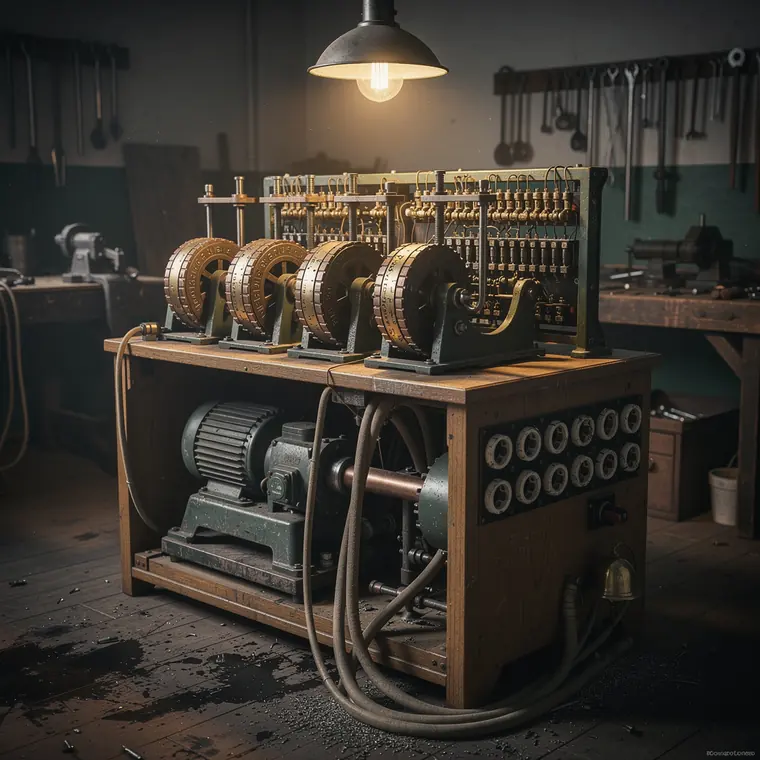
A wooden cabinet the height of a desk carrying six full sets of cipher rotors on vertical shafts along its top, each set a stack of three brass rimmed discs, the six sets arranged in a row and driven together by a single electric motor through a belt and shafts, a bank of electrical relays mounted on the panel behind, thick cloth covered cables looping from the rotor sets down to a panel of plug sockets, a switch and a signal bell at the side, the machine standing in a workshop room of the late 1930s, one bare bulb in a tin shade hanging low above the rotor sets, oil stains on the wooden floor, a workbench with tools receding into the dark.
- What it was used for
- An electromechanical search machine of the Polish Cipher Bureau. Six were built, one for each of the six wheel orders then possible, by the Warsaw firm AVA Wytwórnia Radiotechniczna in November 1938 according to David Link's study. Each held six sets of Enigma rotors driven by an electric motor. They hunted for "females", that is identical cipher letters at positions 1-4, 2-5 and 3-6 of the doubly enciphered message key. Running all 17,576 positions on six bomby in parallel took, in Link's words, "about 100-120 minutes", testing two to three settings per second.
- What was new
- As the first cryptanalytic machine designed to attack Enigma, in the words of the IEEE Milestone, the bomba took over not the looking-up but the searching: it tested position after position and stopped when a condition was met. The price was dependence on an enemy procedure, the twice sent message key. The barb arrived within a month: in December 1938 the Wehrmacht issued two further rotors, the number of wheel orders rose from 6 to 60, and six bomby would have had to become sixty. That the British Bombe of 1940 was a copy is denied by Joan Murray, who worked at Bletchley Park herself: "the Polish bombe was very primitive; while the wartime bombes were direct descendants of this, they were certainly not replicas, vital improvements in the logic having been made by the British in 1940."
Connections
Every connection names its kind. “Forerunner” on its own would be a claim.
- EncounteredThe Pyry Forest Handover1939Marian Rejewski and his colleagues of the Polish Biuro Szyfrów developed the bomba kryptologiczna in September 1938. In July 1939, at Pyry outside Warsaw, the French visitors and, for Britain, Denniston and Knox learned of it; Welchman writes that the Poles told Knox about the bomba and the cyclometer. GCHQ records that the Poles were much further forward.Source: GCHQ: The Pyry Forest Meeting · Agencja Wywiadu (Polen): Enigma decryption · Gordon Welchman, From Polish Bomba to British Bombe: The Birth of Ultra, Intelligence and National Security 1:1 (1986), S. 71-110
- Follows fromEnigma I with Plugboard1932The bomba was built to Rejewski's plans by the AVA Radio Manufacturing Company, which also made the Polish Enigma copies; in the NSA's account it resembled three linked pairs of such duplicates. It was meant to work through the more than 17,000 rotor positions by brute force. Together with Zygalski's sheets it found solutions in two hours or less through 1938.Source: Jennifer Wilcox: Solving the Enigma - History of the Cryptanalytic Bombe. Center for Cryptologic History, National Security Agency
Further reading
- David Link: Resurrecting Bomba Kryptologiczna. Archaeology of Algorithmic Artefacts, I (Cryptologia 33:2, 2009)
- Joan Murray: A Personal Contribution to the Bombe Story (NSA, freigegebenes Dokument, DOCID 3269230)
- IEEE Milestone: First Breaking of Enigma Code by the Team of Polish Cipher Bureau, 1932-1939