Venona Sheets
1943 · Duplicate Key Analysis · Work 477 of 1,871
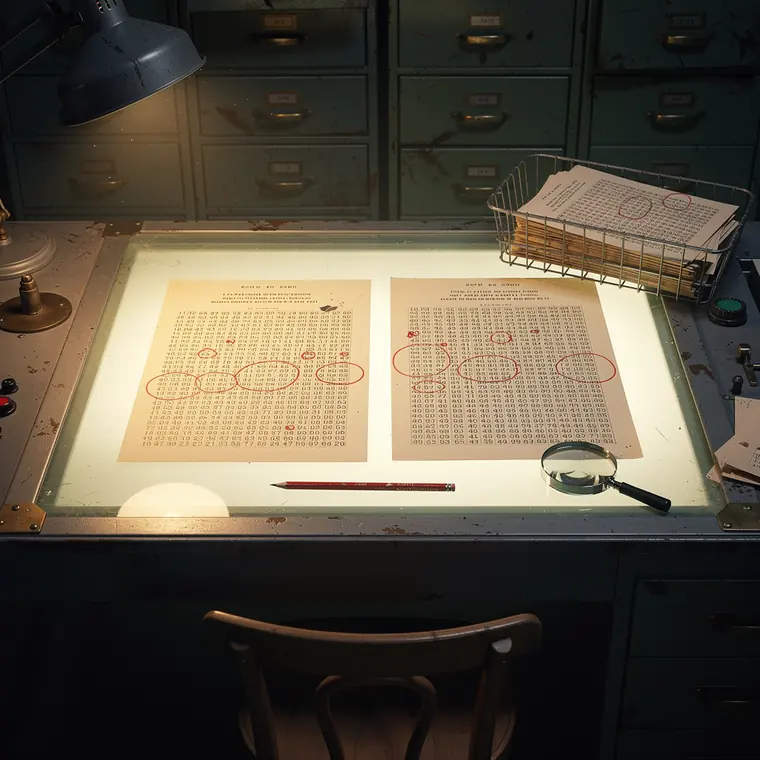
Two intercepted message sheets laid side by side on a glass light table, columns of five-digit number groups typed on each, several groups circled in red pencil on both sheets, the circled groups lying at the same positions on each sheet, a red pencil and a magnifying glass at the edge, a stack of further sheets in a wire tray at the corner, the light glowing up through the paper as the main light, the sheets bright against the dark surround, a wooden chair pushed back, a filing cabinet and the rest of the analysis room in darkness.
- What it was used for
- On 1 February 1943 the U.S. Army's Signal Intelligence Service at Arlington Hall began a small, very secret program, later codenamed Venona, to examine encrypted Soviet diplomatic communications. Per NSA's own account it was started by Gene Grabeel, a schoolteacher only weeks earlier; per the NSA/CIA conference volume the order came from Col. Carter Clarke, who was concerned that Moscow and Berlin might negotiate a separate peace. Grabeel stayed with the work for 36 years. The traffic had been accumulated since 1939 and had not been studied before. The worksheets served to find duplicated one-time pad pages and align them against each other.
- What was new
- Nothing was invented. What was new was the point of attack: not the algorithm but the manufacture of the key. A one-time pad is unbreakable if used once; NSA's account says the KGB's manufacturing centre apparently reused pages. Cecil Phillips puts it more precisely: for a few months in early 1942, a time of great strain, the centre for some unknown reason printed duplicate copies of the key on more than 35,000 pages and bound them into pads. The duplicates show up in traffic from mid-1942, and in one circuit as late as June 1948. Result: about 3,000 messages translated per NSA, roughly 2,900 per the NSA/CIA conference volume; NSA gives no denominator, only "thousands", and says only a fraction was available to the cryptanalysts. Readability was spotty: 49 per cent of the 1944 KGB New York to Moscow messages, 15 per cent of the 1943, 1.8 per cent of the 1942.