The Dismantling
1945 · Ordered Destruction · Work 478 of 1,871
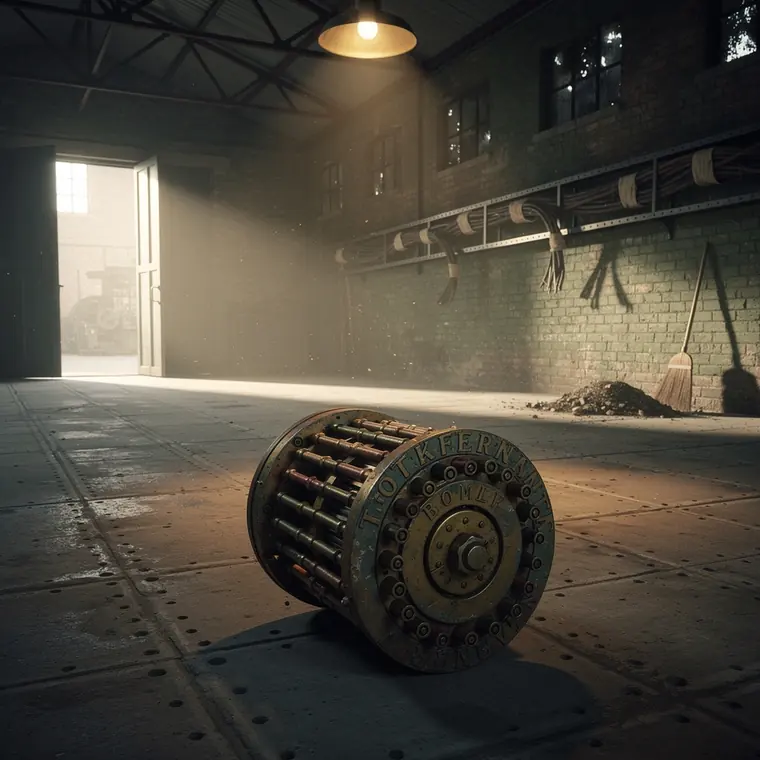
An emptied machine hall, bolt holes and pale rectangles on the concrete floor where cabinets had stood, a single Bombe rotor drum the size of a dinner plate left lying on the floor, its rim painted in one colour band and engraved with a ring of capital letters catching the light, cable ends cut flush and wrapped with tape hanging from a wall trunking, a broom leaning in a corner beside a heap of swept dust, the tall doors standing open to bright daylight, dust hanging in the shaft of light across the concrete, the far end of the hall in shadow, bare brick walls, a steel roof truss and a row of dark windows high up.
- What it was used for
- The breaking up of the British codebreaking machines after the war. Tony Sale: eight of the ten Colossi were dismantled at Bletchley Park, two went to Eastcote in north London and then to GCHQ at Cheltenham; the IEEE Milestone proposal dates the move to Eastcote to April 1946 and to Cheltenham to 1952-54. Parts went, sanitised as to their original purpose, to Max Newman's Computing Machine Laboratory in Manchester. Flowers was ordered to destroy his Colossus documents and burned the drawings and plans in the boiler fire; his colleague Coombs's papers survived. Of the British Bombes, per TNMOC about 50 were temporarily retained and the rest dismantled.
- What was new
- No innovation can be shown here, and the much-repeated version does not hold. That Churchill ordered the destruction appears in Copeland without a footnote where neighbouring sentences carry them; later, in another context, he quotes a letter from the codebreaker Jack Good beginning "I heard that". Herbert Bruderer, writing for the ACM, calls it a rumour and evidently false and points to Tony Sale's sequence. The IEEE proposal, Sale, TNMOC and the Bletchley Park Trust all describe the dismantling without naming Churchill. The dates tell against the strong version: the two survivors went on running at GCHQ, Colossus Blue until 1959, the second per IEEE in the 1960s, per Copeland believed to have stopped in 1960, per Sale about 1960. The drawings, per Sale, were burnt only in 1960.
Connections
Every connection names its kind. “Forerunner” on its own would be a claim.
- EncounteredColossus Mark 21944The dismantling fell on the machines themselves: of the ten running at Bletchley Park at the 1945 surrender, all but two were taken apart and their parts returned to the Post Office. Two went to Eastcote in April 1946; they were dismantled in 1959 and in the 1960s.Source: IEEE Milestone: The Colossus Computers, 1944-1945 (Engineering and Technology History Wiki) · B. Jack Copeland: Colossus - Breaking the German 'Tunny' Code, The Rutherford Journal