Colossus Mark 2
1944 · Valve Computer · Work 474 of 1,871
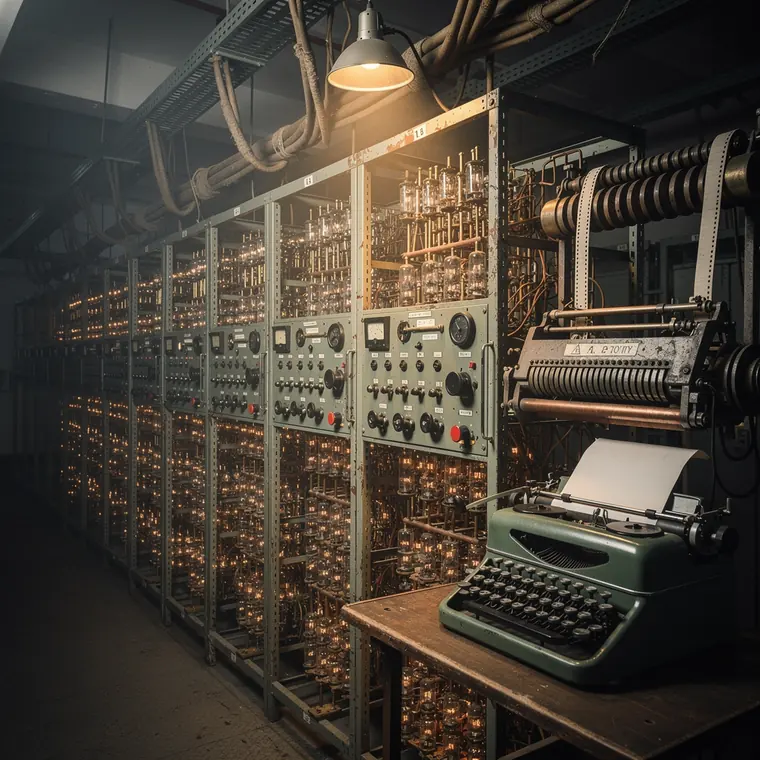
The enlarged valve machine with some twenty-five hundred valves in a longer bank of steel racks, the racks in a row along the room, five parallel processing channels marked by five identical panels of switches, a punched paper tape loop over a bedstead of pulleys at the side, an electric typewriter on a side table printing results onto a blank sheet, cable trays running overhead, a single work lamp from above at an angle, glowing valves and grey steel, the far racks fading into darkness.
- What it was used for
- The enlarged form that carried the Newmanry's work to the end of the war. The IEEE Milestone proposal gives 1 June 1944 as the date it first ran satisfactorily, five days before the Normandy landings. Valve count: about 2,400 per Copeland, over 2,400 per the IEEE proposal, 2,500 per the Bill Tutte Memorial. The tape still ran at 5,000 characters per second, but per Copeland the machine processed five streams of dot and cross simultaneously, in parallel, so 25,000 characters per second in effect. Tony Sale counts ten Mark 2 machines in the Park at the end of the war; the General Report on Tunny records 273 Wrens, 26 cryptographers and 28 engineers for May 1945.
- What was new
- Not more speed at the tape but five counting units on one tape. The five-fold parallelism gave a factor of five because the tape was already at its limit: the IEEE proposal gives 5,000 characters per second as the working figure and tests up to 9,700, at which the tape disintegrated. The mechanical limit was paper, not electronics. How far beyond this the Mark 2 was programmable is not entirely undisputed; its builders published details of the machines as early as 1983, while GCHQ deposited the General Report on Tunny only in October 2000; the valve count, too, is not uniformly reported.
Connections
Every connection names its kind. “Forerunner” on its own would be a claim.
- Follows fromColossus Mark 11943Mark 1 was operational in January 1944 and was succeeded as early as June 1944 by Mark 2. The improved Mark 2 used shift registers to quintuple the processing speed and first worked on 1 June 1944, just in time for the Normandy landings.Source: IET, 100 Ideas: Colossus · Tony Sale (Codes and Ciphers Heritage Trust): The Colossus
- Works withNewmanry Tape Loops1944Colossus needed only one tape, the one carrying the ciphertext, which did away with synchronising two loops. The prototype read 5,000 characters per second; the later machines processed five streams in parallel and so reached 25,000 characters per second.Source: B. Jack Copeland: Colossus - Breaking the German 'Tunny' Code, The Rutherford Journal
- EncounteredThe Dismantling1945At the German surrender in 1945 ten Colossus machines were working at Bletchley Park. After the war all but two were dismantled and the parts returned to the Post Office; the remaining two went to GCHQ at Eastcote in April 1946. Flowers was ordered to burn his drawings.Source: IEEE Milestone: The Colossus Computers, 1944-1945 (Engineering and Technology History Wiki) · B. Jack Copeland: Colossus - Breaking the German 'Tunny' Code, The Rutherford Journal