The Proletarians of Europe
1856 · People's Paper Banquet · Work 480 of 1,871
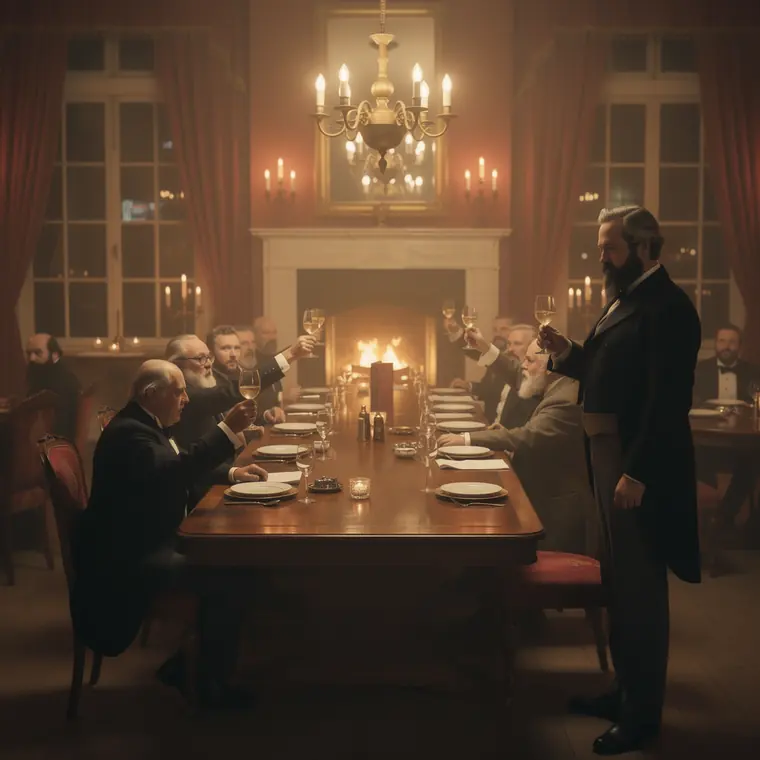
The dining room of a hotel on the Strand, London, past nine on the evening of 14 April 1856, a long room with dark red papered walls, a corniced plaster ceiling, drawn crimson curtains at the windows, wall gas brackets burning warm yellow, a coal fire at the far end, a long table down the room, its cloth cleared to bare polished mahogany with wine glasses and decanters, some forty men seated close along both sides, compositors in brown and grey working jackets with coloured neckcloths, gentlemen in black frock coats, a few Frenchmen with pointed beards, every face turned to one man, standing at his place on the right side of the table a third of the way down from the camera, risen from his chair, a glass raised in his right hand, is the man, a thick-set man of thirty-seven with a broad forehead, dense black hair and a full black beard showing the first grey threads, in a black frock coat and dark cravat, his face turned up the table to the camera as he speaks, at the near end the back of the chairman's head cut by the lower frame edge, the seated men in profile and shadow.
- Who
- Karl Marx (1818–1883) was a philosopher, economist and journalist. Born in Trier, the son of a lawyer, he studied in Bonn and Berlin and edited the "Rheinische Zeitung" in Cologne in 1842–43. With Friedrich Engels he wrote the "Manifesto of the Communist Party", published in February 1848 and ending with the call "Workers of all countries, unite!". Expelled from Germany in 1849, he lived in London from then until his death, for long years in deep poverty; four of his seven children died before the age of ten, and he had a son with his housekeeper Helena Demuth. Engels supported the family with money. In 1864 Marx played a leading part in founding the International Working Men's Association, and in 1867 the first volume of "Capital" appeared. Only the twentieth century turned him into the patriarch of communism: dictatorships invoked him, and they cost millions of lives in the Soviet Union, in China and elsewhere. Marx was not responsible for those crimes, but his writings served them as theoretical foundation.
- The moment
- On the evening of 14 April 1856 the Chartist Ernest Jones entertained the compositors and staff of his paper, The People's Paper, at a supper in the Bell Hotel on the Strand in London, joined by leading democrats of England, France and Germany then living in London. The meal began at seven; at nine the cloth was cleared and the toasts began. Jones, in the chair, proposed the first: "The proletarians of Europe". The reply fell to Marx, aged 37, the only one of the whole emigration to be invited, who answered in English with a short speech. The picture shows him at that moment, glass raised. He spoke of machines that were not in the room: steam, electricity and the self-acting mule were "revolutionists of a rather more dangerous character than even citizens Barbès, Raspail and Blanqui". Machinery, gifted with the power of shortening human labour, was starving and overworking it. His last sentence: "History is the judge – its executioner, the proletarian."
- The other side
- The machine was not in the room but in the sentence – and Marx meant that sentence never to be printed. Two days later he wrote to Engels that he would not allow the speech to appear in print. On 19 April it appeared all the same in The People's Paper, in the report on the supper; that newspaper report is the form in which it survives. In the same letter Marx said quite openly what he had wanted to achieve: Talandier, a Frenchman who had to pay for his ticket, was now convinced, like the rest of the émigrés, that Marx and his friends were the Chartists' only intimate allies.
What the sources leave open: Which house "Bell Hotel, Strand" refers to cannot be determined; the room in the picture is typified. Whether Marx spoke standing is not recorded. The report mentions a numerous company "of both sexes"; in the picture only men sit at the table. No photograph of Marx exists before 1861; the face follows Richard Beard's picture of 1861, painted five years younger.
Further reading
Sources
- Deutsches Historisches Museum, LeMO: Karl Marx (1818–1883), Biografie
- Harvard University Press: Gareth Stedman Jones, Karl Marx. Greatness and Illusion (2016), Verlagstext – erst das 20. Jahrhundert machte Marx zum 'Communism's patriarch'
- Die Landesbeauftragte zur Aufarbeitung der SED-Diktatur Sachsen-Anhalt, Pressemitteilung A 10/2018 vom 7.5.2018 (Marx als theoretische Grundlage kommunistischer Diktaturen, nicht verantwortlich für deren Verbrechen)
- Marx, Speech at the Anniversary of The People's Paper, 14.4.1856, mit Zeitungsbericht und Anmerkungen (MESW/MECW 14) – Marxists Internet Archive
- Marx, Rede auf der Jahresfeier des People's Paper (MEW 12, S. 3–4; People's Paper Nr. 207 vom 19.4.1856) – Marxists Internet Archive, deutsch
- Marx an Engels, London, 16. April 1856 (MECW 40, S. 37) – Marxists Internet Archive, Spiegel architexturez