Müller's Proposal
1786 · Difference Engine, Proposed · Work 481 of 1,871
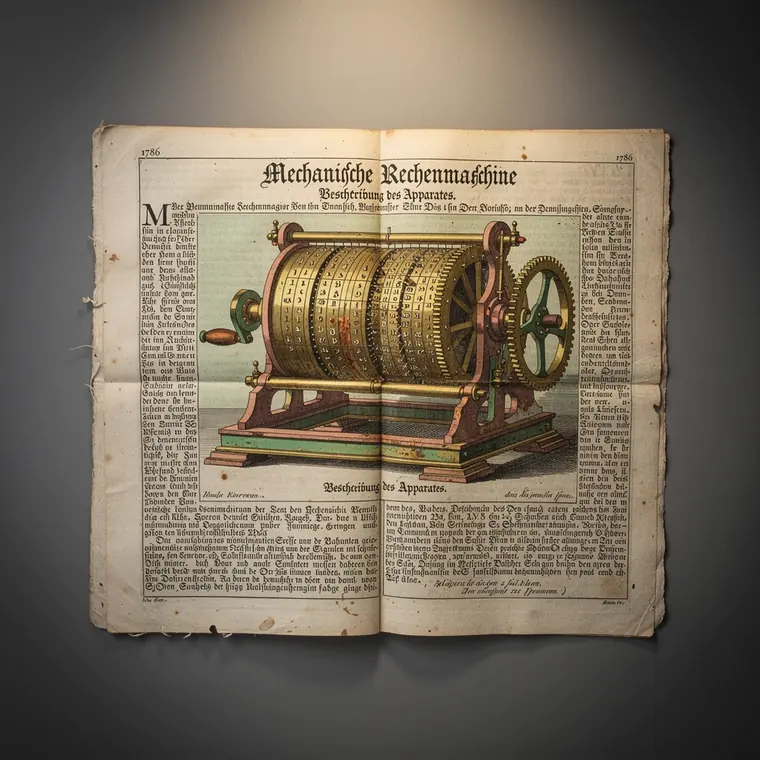
A bound pamphlet lying open at a folded copper-plate engraving of a drum-shaped pinwheel calculating machine with a crank at its side, the surrounding text in German fraktur reading as grey texture, the paper foxed at the edges, laid flat on a grey studio table, even flat light from directly above.
- What it was used for
- Johann Helfrich Müller (1746-1830) served the Landgraves of Hesse-Darmstadt, from 1777 as Landbaumeister and from 1778 as engineer and artillery captain. He built a four- function stepped-drum calculating machine, 16 centimetres high and 33 centimetres across, which per the HNF he demonstrated at Göttingen on 24 June 1784 before Georg Christoph Lichtenberg; the Arithmeum gives 14 digits for input, 14 for the revolution counter and 14 for output, and the ability to calculate in positional systems other than decimal. With it he computed the timber-volume tables published in 1788, 226 pages, per the HNF probably the first work produced with calculating machinery. The 1786 publication, edited with a preface by Ph. E. Klipstein, is a manual of about 50 pages with a two-page appendix on further inventions of superior calculating machines and an arithmetical printing machine.
- What was new
- The dates here are of different kinds, and that settles the matter. The idea of a machine to compute and print tables by the method of differences appears, per the HNF, first in an unpublished letter of 18 September 1784 to Albrecht Ludwig Friedrich Meister, three months after the Göttingen demonstration; the same account says the 1786 publication only hinted at it. "Müller's proposal, 1786" is therefore the printed hint, not the first formulation. The machine was never built. The years of the calculating machine are also of different kinds: the Arithmeum gives 1783 as the year of invention, per the HNF it was finished in 1784; both have it demonstrated in 1784. The barb lies in the idea's route: per historyofinformation.com Babbage owned a copy of Müller's book that Herschel had found on a trip to the Continent; the HNF holds only that Babbage possibly knew the relevant pages.