Mechanical Notation
1826 · Babbage's Notation · Work 482 of 1,871
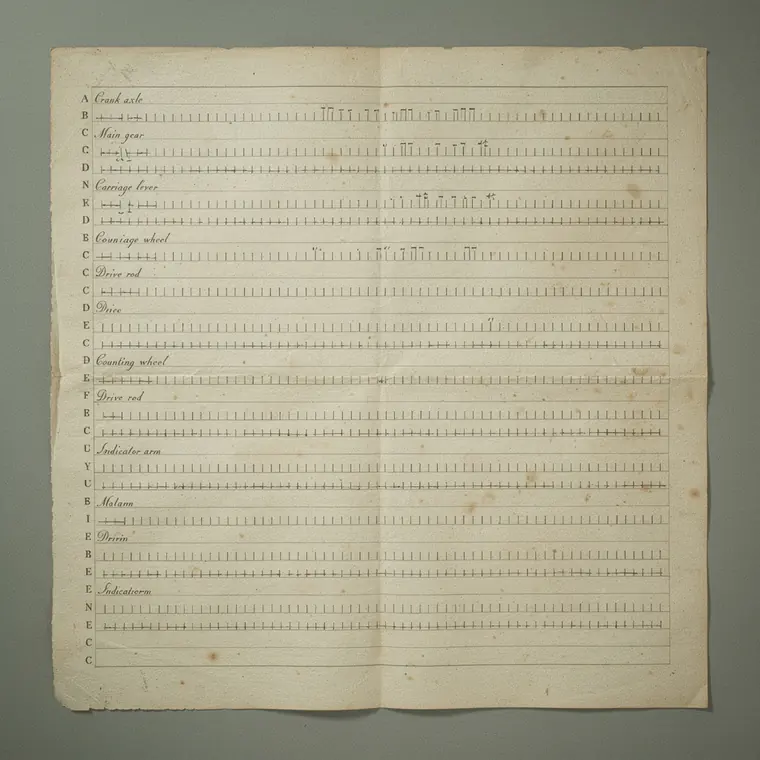
A large drawing sheet covered in Babbage's mechanical notation, a timing chart of the moving parts of a calculating engine, long horizontal ruled lines running the full width of the sheet, each line labelled at its left end with the name of a machine part in small copperplate handwriting, short vertical strokes, square brackets and small arrowheads marked along the lines to show when each part moves, a narrow ruled column of letter symbols down one side, the whole in black ink on cream paper, the sheet lying flat on a grey studio table seen from directly above, its four corners resting free on the table, even flat light from directly above.
- What it was used for
- A system of signs by which Babbage recorded which part of a machine moves when, driven by what, and in what order. Communicated 17 January 1826, read to the Royal Society on 16 March 1826, printed in the Philosophical Transactions, volume 116 (1826), pages 250 to 265, with four engraved plates. The paper itself states the occasion: in constructing his engine he experienced great delay and inconvenience from the difficulty of ascertaining from the drawings the state of motion or rest of any individual part at any given instant, and much more so for several parts at the same moment. It recorded every moving part with an indicating line, the drawing reference, the number of teeth, pins or studs, three lines of velocities, the origin of motion traced by arrows back to the prime mover, and the adjustments numbered in the order they must be made. Worked examples: the eight-day clock and the hydraulic ram.
- What was new
- Not the first representation of machinery but one that expresses time: a drawing shows a machine in one state, whereas per Babbage the Notations of Periods gave the time and duration of every motion, the contemporaneous as well as the successive. Adrian Johnstone explains why it was scarcely needed: steam engines and pumps have no memory, each rotation is as the last, the geometry drawing suffices; only memory generates complex time-dependent behaviour. In 1864 Babbage called the notation one of the most important additions he had made to human knowledge. The barb: his prediction that no school of mechanical drawing would be thought complete without teaching it did not come true. Bruce Collier judged in 1970 that it was perhaps too complex and arbitrary to be learned easily and too geared to Babbage's own modes of thought. Doron Swade, rebuilding Difference Engine No. 2, turned to it only as a last resort.
Further reading
- Charles Babbage, On a Method of Expressing by Signs the Action of Machinery, Philosophical Transactions 116 (1826), 250-265 (Scan/OCR)
- Charles Babbage, Passages from the Life of a Philosopher (1864), Kap. IX und XXXIV
- Adrian Johnstone, Babbage's Language of Thought, Plan 28 Blog, 28.11.2014
- Notions and Notation: Babbage's Language of Thought, Royal Holloway (mit Collier-Zitat 1970)
- Doron D. Swade, The Construction of Charles Babbage's Difference Engine No. 2, IEEE Annals of the History of Computing (2005)