The Treasury Closes the Account
1842 · Cancelled · Work 485 of 1,871
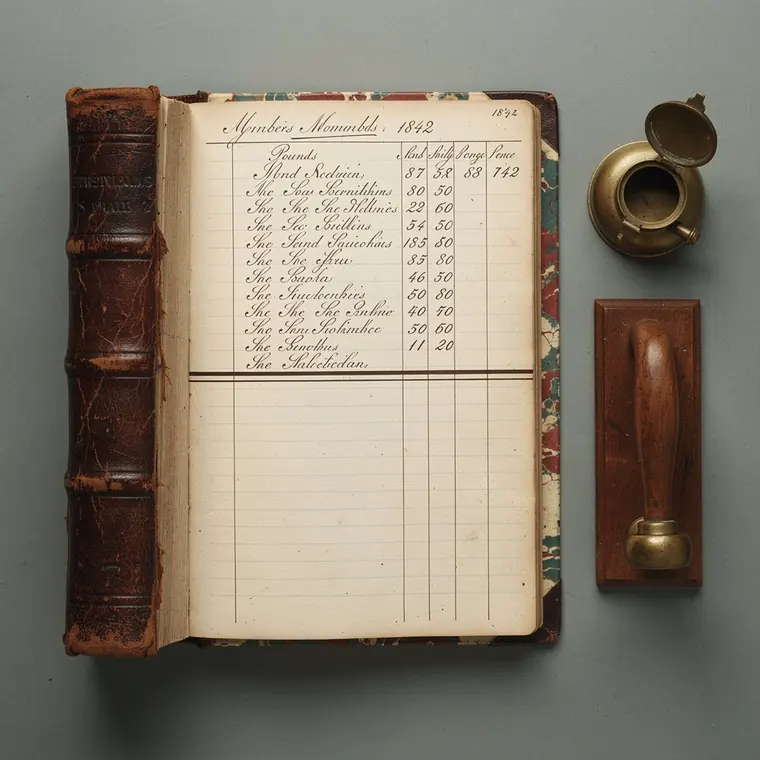
A government ledger of 1842 lying open at a ruled page, a tall account book bound in worn brown leather with marbled edges, entries in copperplate script running down ruled columns of pounds, shillings and pence, the final line closed off with a double rule drawn beneath it in ink, the page below the rule left plain, a brass inkwell with a dry well and a wooden blotter beside the book, the ledger laid flat on a grey studio table, even flat light from directly above.
- What it was used for
- The administrative act that ended the project. The statement drawn up by Sir Harris Nicolas from Babbage's papers gives the sequence: on 8 October 1842 he again wrote to Sir Robert Peel, then First Lord of the Treasury, requesting an early decision. On 4 November 1842 a note from Peel explained that he had wished to speak with the Chancellor of the Exchequer first; the same day the Chancellor, Henry Goulburn, wrote that he and Peel both regretted the necessity of abandoning the completion of the machine, because the expense of rendering it either satisfactory to Babbage or generally useful appeared, on the lowest calculation, so far to exceed what they would be justified in incurring that they saw no other alternative. Goulburn offered Babbage the machine as already constructed; on 6 November Babbage declined; on 11 November he obtained an interview with Peel which he recorded as entirely unsatisfactory.
- What was new
- Nothing was invented; a dating needs clarifying. The project is usually taken to have failed in 1833, but the engagement was only terminated in November 1842, and Babbage dated the standstill to 1834: no progress whatever had been made since 1834. The sums are given differently. Babbage wrote to Lord Derby in 1852 that the Government spent about £17,000 on the first Difference Engine, while out of his own private resources he had sacrificed upwards of £20,000 on this and other works of science. The Computer History Museum gives £17,500 and compares it with the cost of twenty-two brand new steam locomotives from Robert Stephenson's factory in 1831. The barb: the decision followed the Treasury's cost reckoning and, by Babbage's account, came eight years late. In exactly that waiting period, by Babbage's own account, all the principles of the Analytical Engine were found - the delay produced a better machine, which was then not funded either.